In conversation with Julia Blaker, Cut-Out Artist, Mixed-Media Painter, Folk-Art Storyteller
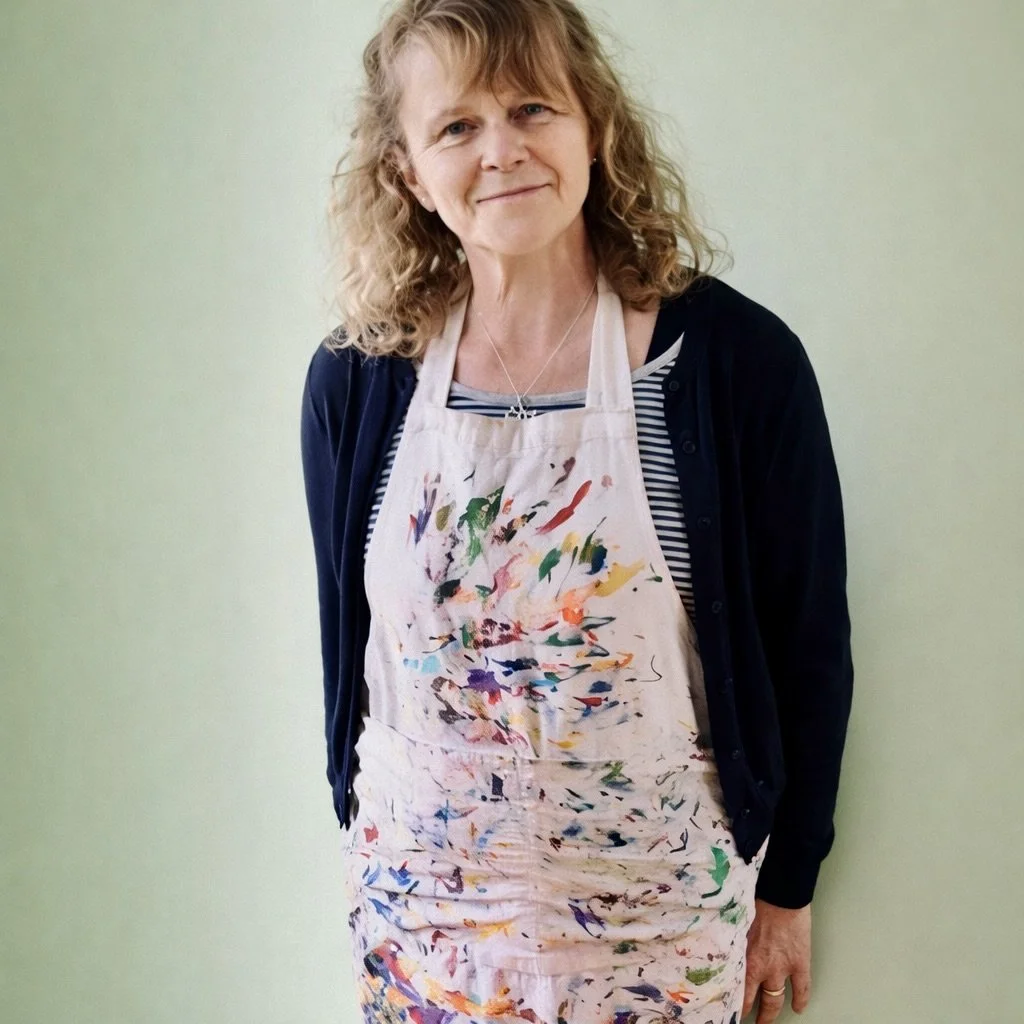
Julia Blaker in her element — paint-splattered apron, soft smile, and the quiet confidence of someone who has spent a lifetime making.
Julia Blaker first entered the Asterion & Co. world not as a collaborator but as a guest. She joined one of our gardening workshops — a bright presence among the group, absorbing the teaching and practical day with our tutor, Chris Smith. Even then, something about her manner stood out: a natural attentiveness, an ease with strangers, and a generosity in the way she listened. It was only later, when we sat together at her kitchen table in her warm yellow kitchen, that the breadth of her creative world truly came into view.
The room seemed to tell her story before she did. Against the sunny walls stood one of her painted cabinets — a folk-art object so joyful and narrative-rich it pulls you in from across the room. Deep blue wood frames two hand-painted panels alive with swirling seas, whales breaching through stylised waves, a tall ship catching star-shaped light, and lines from John Masefield’s Sea Fever running around the borders like illuminated manuscript ribbons. The palette — cobalt, crimson, mustard, seafoam — sings with the movement and emotional rhythm that define her practice. It is the sort of object that feels both deeply personal and timeless, belonging as much to a remembered maritime tale as to Julia’s own daily life. Encountering it, you understand something essential about her: she is an artist who builds worlds, not merely images, and allows those worlds to spill generously into the spaces she inhabits.
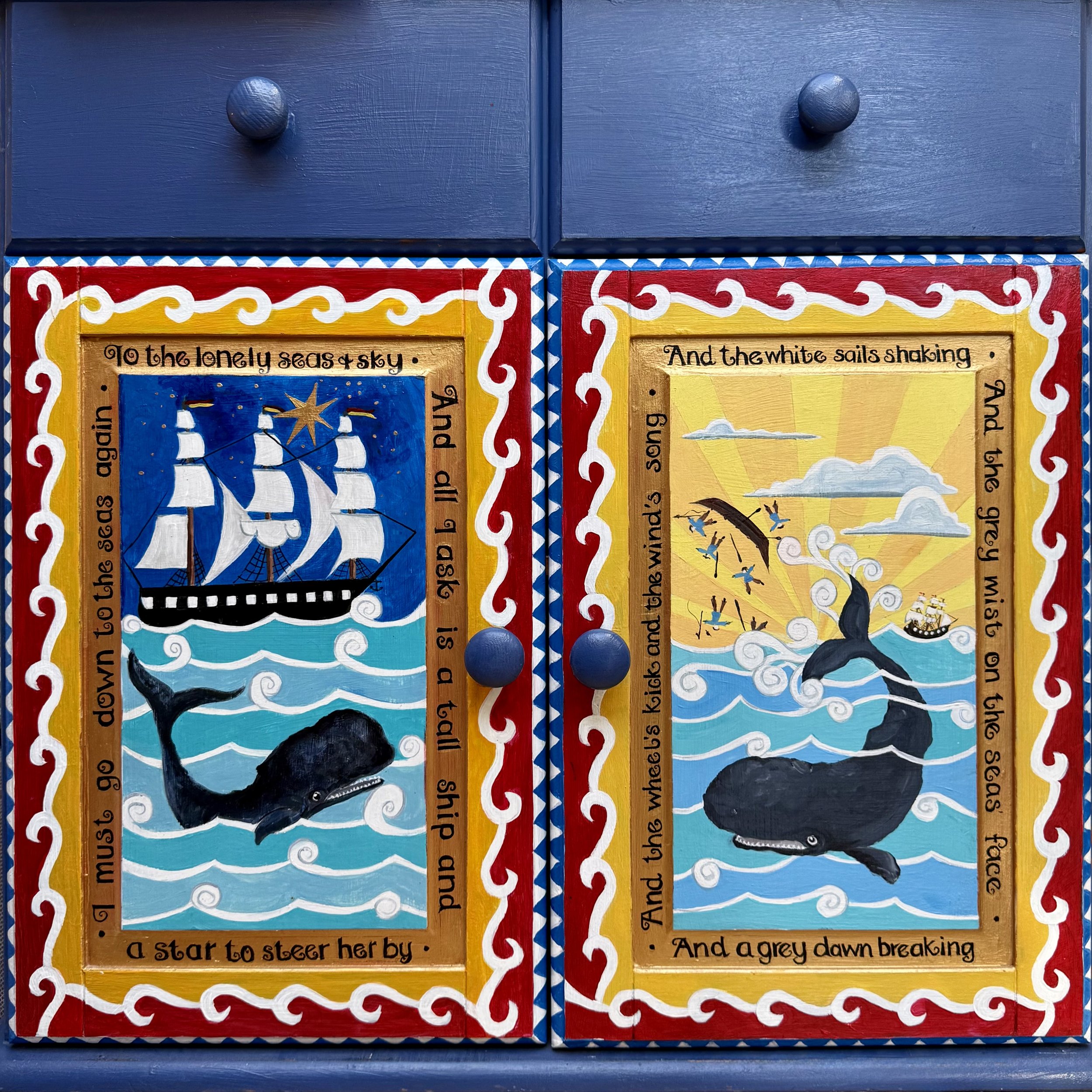
Julia’s signature world-building in miniature — vibrant, joyful, and instantly recognisable as hers.
Her home radiates the layers of a life shaped by making: objects, textures and colours speaking quietly to one another, revealing a woman who understands creativity not as performance, but as a way of being in the world.
Julia describes herself in many ways — a cut-out artist, a mixed-media painter, a folk-art storyteller, a former ceramicist, a lifelong maker — yet a single thread binds them all: her instinct for creating ease, connection and confidence. She understands, at a deep and almost cellular level, how creativity emerges when people feel relaxed and unafraid. “One of the most important aspects of running any sort of group,” she reflects, “is to create a relaxed and comfortable environment free from competition and judgement.” Over the years, she has become remarkably skilled at this. Her classes are full of gentle humour, shared discoveries, and the soft camaraderie that grows when people make things side by side — hands busy, hearts quiet, conversation unfolding without effort.
An academic grounding in art
Her artistic foundations stretch back to an early and enduring love of art history. Julia studied at the prestigious Courtauld Institute, a training that sharpened her eye and instilled in her a reverence for the visual languages developed across cultures and centuries. Later she had roles in the Oriental Art Department of the British Museum and she worked in the Victoria & Albert Museum. Each day spent among carved objects, textiles, ceramics, manuscripts and global craftsmanship became a kind of apprenticeship in looking — attentive, humble, fascinated looking. She absorbed not just technique, but the emotional force of storytelling through materials.
Alongside these formal influences sits the presence of her mother, the earliest and strongest creative figure in her life. In keeping with an Asterion tradition — where each collaborator gifts a final question for the next — Julia answered the one passed on by botanical illustrator Kate Charlton: Which person has been the greatest influence on your creative life? “My mother was probably the most momentous influence on my creative life and so it’s her presence that I feel most strongly,” she reflects. “But I feel the echoes of all sorts of times, places and people from the past that come together to dictate what I do now in terms of my vision of the world.” She speaks of her mother with warmth and clarity, as though her imagination is still threaded through Julia’s own. These influences — academic, professional, familial — merge into a vision shaped by curiosity and emotional honesty. Her work feels both timeless and intimately personal: rooted in memory, yet alive to the present moment.
The pull of the West Country
Somerset, however, is where her creativity finds its true equilibrium. After 20 years working and teaching in ceramics — a discipline that demands patience, sensitivity to material, and a tolerance for unpredictability — she felt a shift. Painting began to tug at her, quietly at first and then with irresistible force. The landscape of the Mendip Hills played a pivotal role in this transition. Its flora and fauna offered her not just subject matter but rhythm: a sense of movement, seasonality and life cycles that now echo through her shaped forms.
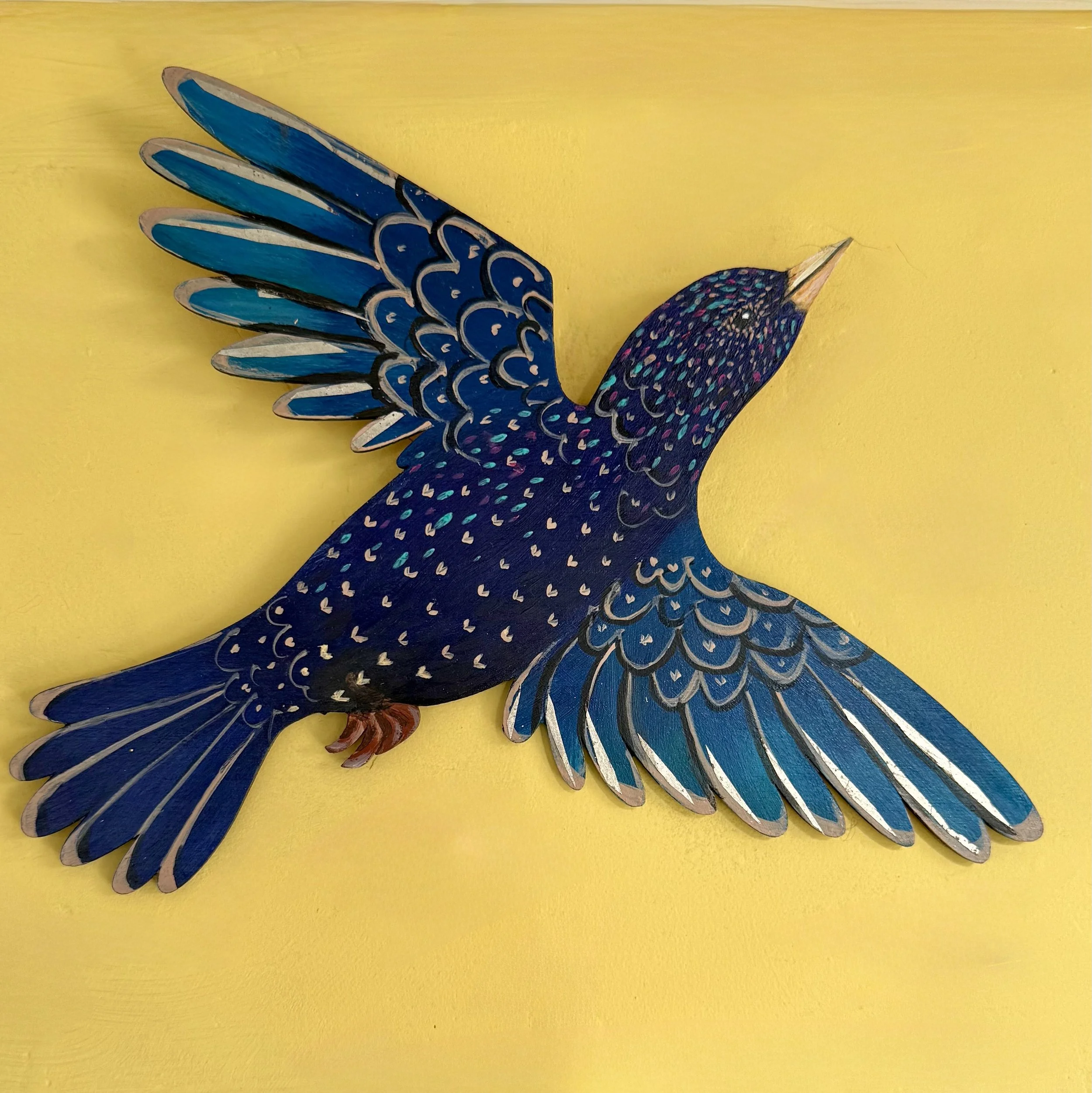
A hand-painted starling taking flight across the warm yellow walls of Julia’s kitchen — her storytelling in winged form.
Her pieces — birds mid-flight, sea creatures on imagined journeys, folkloric silhouettes emerging from half-remembered tales — seem less like inventions and more like beings stepping out from the hillside itself. Traditional canvases soon felt too confining. “Squares and rectangles always seemed so restrictive,” she says with a grin. “I never much liked following the rules… they just make me want to rebel!” Her shaped cut-outs offer her the freedom to let stories curve and extend organically, giving her work a theatrical, almost animated presence.
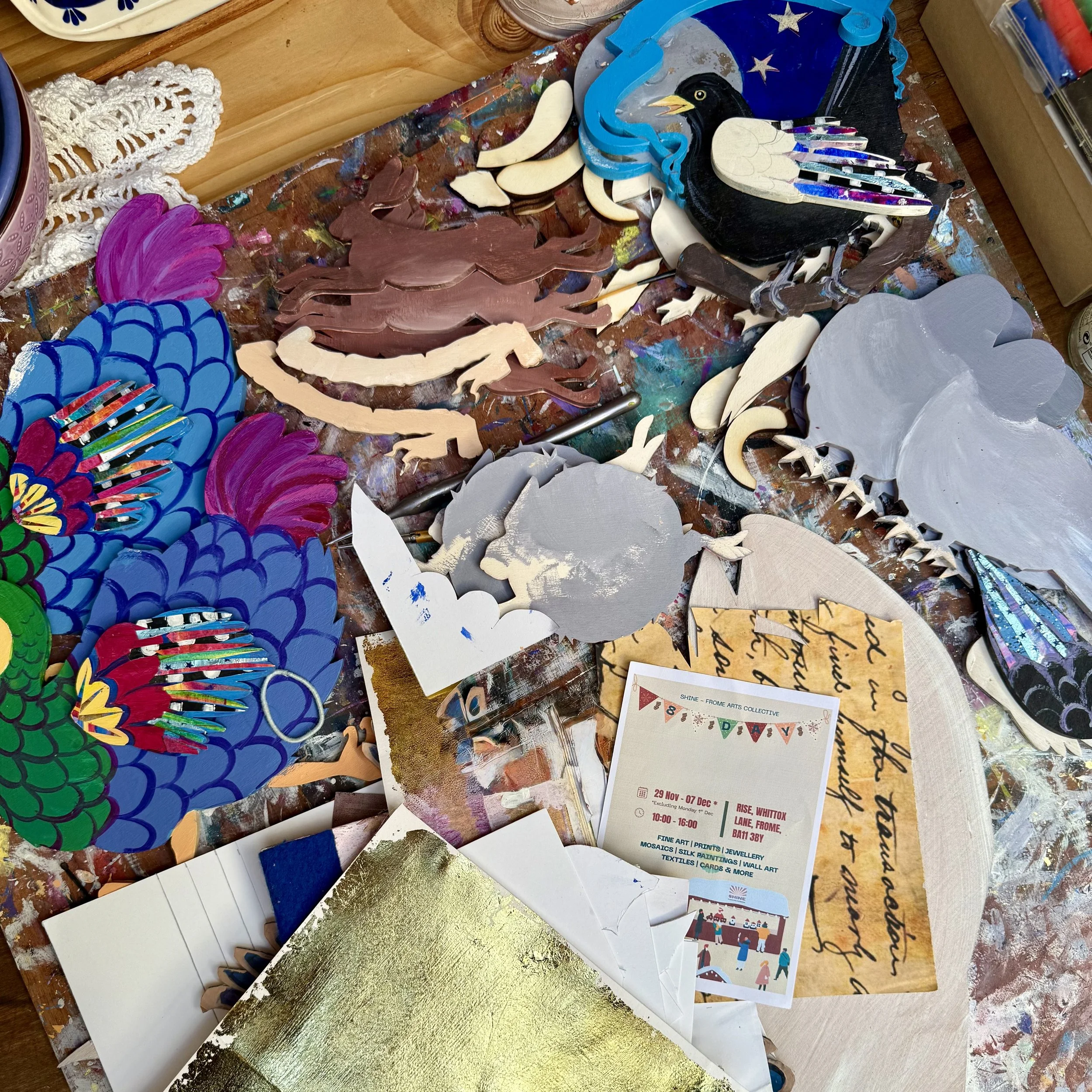
In Julia’s world, colour comes first, then form — the rest of the story unfolds from here.
Colour is her emotional signature. She is drawn instinctively to brightness — vivid blues, vibrant reds, saturated greens — colours that pulse with joy. “We see colour before we make sense of the image,” she explains. “It’s tied to an emotional reaction far more than we realise.” Her palette is intuitive but not impulsive; it is informed by decades spent studying artists across eras, noticing how colour can shift meaning, mood and movement. Even when her pieces are playful, they carry a depth of looking that reflects a lifetime immersed in art.
An innate passion for teaching
Teaching remains, for Julia, a calling as much as a craft. She understands the vulnerability adults feel when returning to creativity after years of self-doubt. Many of her students arrive convinced they “can’t draw,” or “aren’t artistic,” carrying old stories handed to them in childhood. Julia meets this with quiet empathy. She often shares quotes from artists who struggled before them — gentle reminders that uncertainty is universal. She sees her workshops not as technical exercises but as places of renewal, where joy matters more than accuracy and where people can rediscover the confidence of their younger selves. Art, she believes, should always feel like a homecoming.
The Shine Collective
Community enriches her work even further. As a member of the Shine Collective in Frome — eight artists sharing a shop, gallery and the lived reality of sustaining a creative practice — Julia finds companionship, feedback and shared resilience. “It’s a fabulous meeting of hearts and minds,” she says. “Someone to give you feedback, to commiserate, to bounce ideas around.” The collective provides a counterbalance to the solitude of the studio, stitching her individual practice into a wider creative fabric.
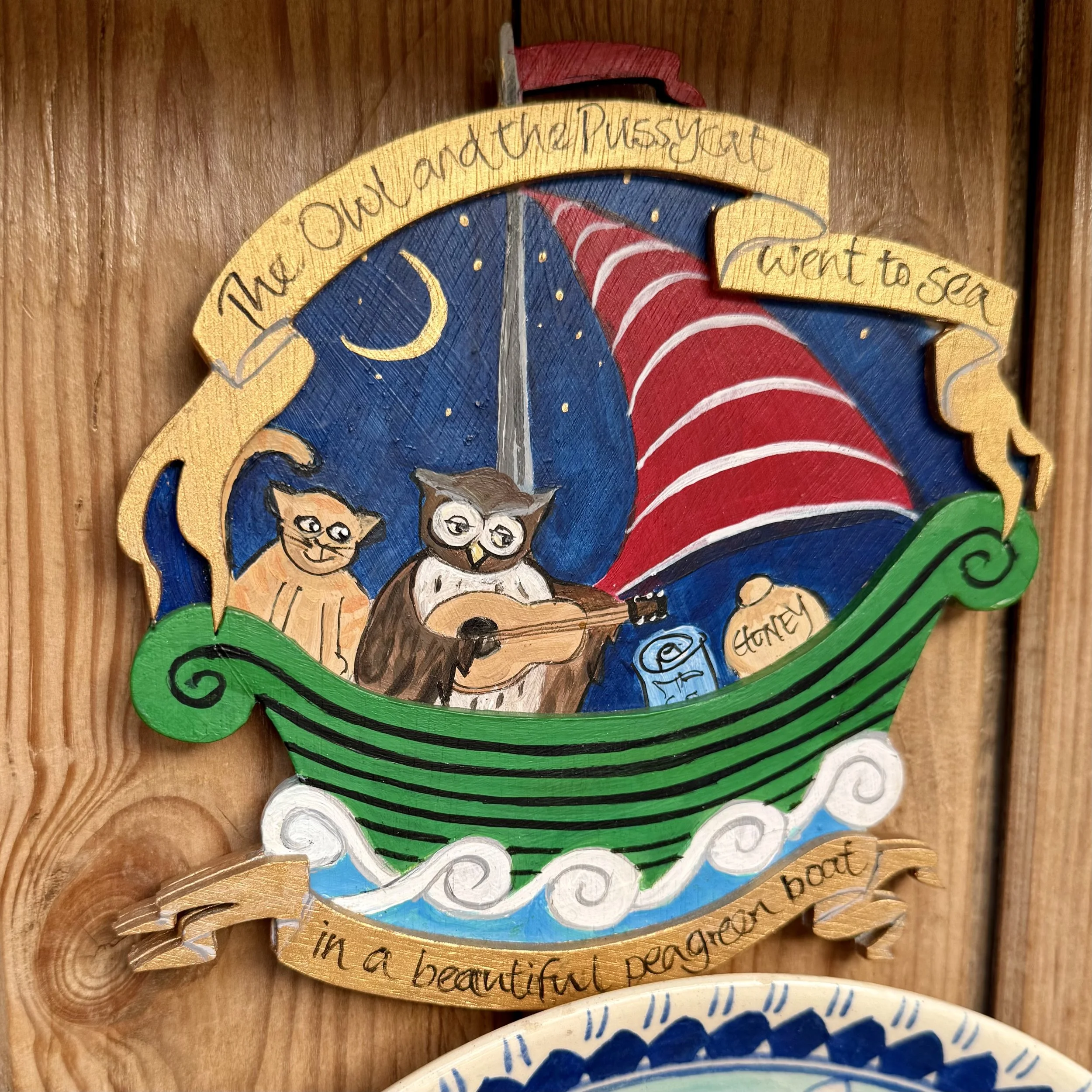
Her first cut-out piece, The Owl and the Pussycat, watching over the kitchen dresser — the starting point of Julia’s storytelling in wood.
Her creative life has never followed a linear or predictable path. “My path was never as clear-cut as some people’s are,” she reflects. Teaching appeared unexpectedly, through the belief of a friend. She also spent over 30 years as a film extra, a role that quietly taught her the long-haul stamina behind any artistic pursuit. Even now, deciding when a piece is finished is an act of trust. “It’s a very inexact science,” she smiles. “Something about the balance of colour, composition and form just seems to gel.”
Across all these chapters runs a single conviction: art belongs to everyone. Not as an abstract idea, but as a lived principle. “Everyone can be an artist whatever your abilities,” she says. “It is the enjoyment of the process which is paramount.” This belief — generous, inclusive, quietly radical — is the foundation of her integrity as both maker and teacher, and perhaps the clearest insight into why her workshops feel so restorative.
In 2026, Julia will join us at Asterion & Co. to lead workshops rooted in her shaped forms, vivid colour and story-rich visual language. We look forward to welcoming guests into Julia’s playful, confidence-building sessions at The Old Vicarage, where her Mendip-inspired approach will guide both beginners and seasoned makers into creative renewal.