In conversation with Emilie Ma, Textile Artist & Sashiko Practitioner
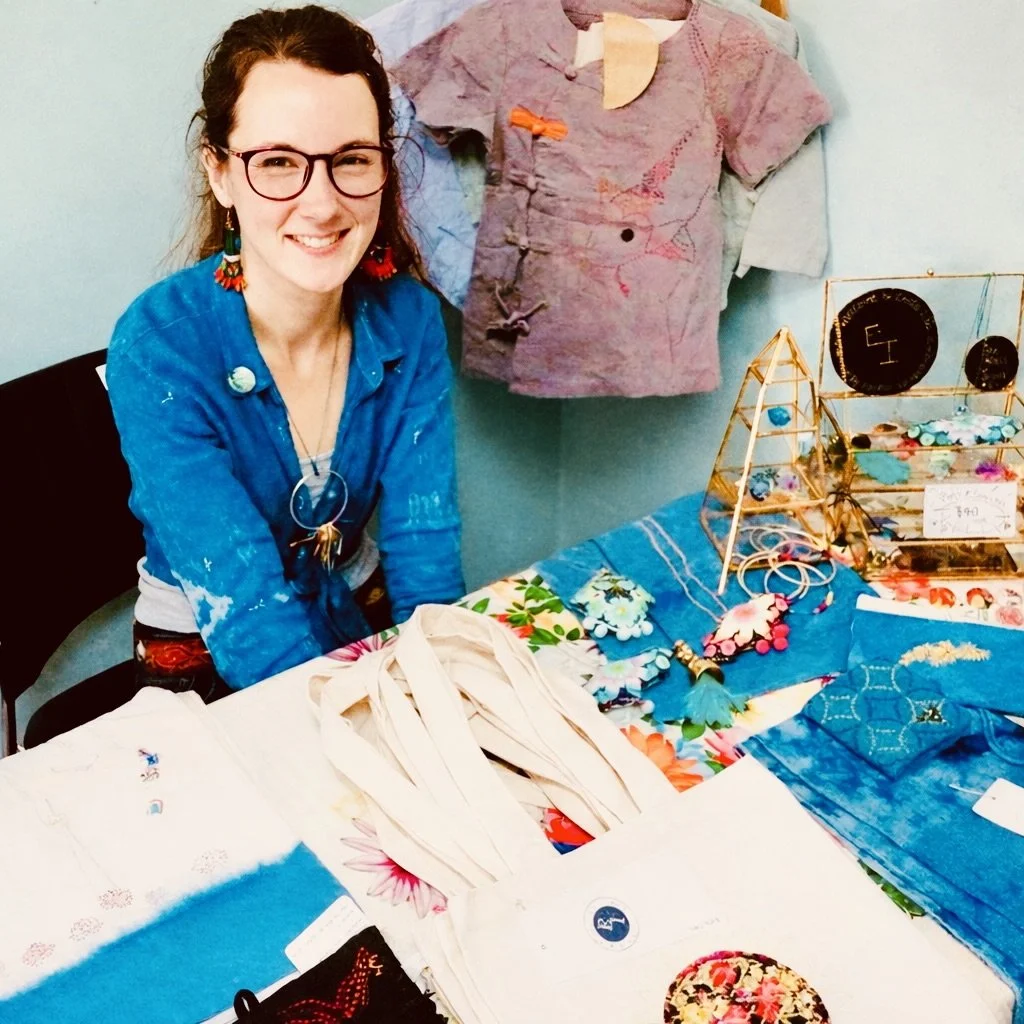
Emilie Ma — attentive to cloth, to memory, and to the quiet discipline of Japanese sashiko, where care is stitched slowly back into the fabric of everyday life.
The first time I met Emilie, she was behind the counter of an art supplies shop in Somerset, gently guiding a customer through the merits of different sketching papers. There was an immediate sense of peace and warmth about her — the kind that very few people possess — a quiet steadiness that hinted at a deeper story. Even in that brief exchange, it was clear she had lived a brave and fascinating life. Her journey had carried her far from home, spending more than a decade immersed in the culture and cadence of China, absorbing ways of seeing and thinking that now shape how she teaches, makes and moves through the world.
We spoke about the Asterion & Co. philosophy of heritage-inspired learning, and when she began describing her Sashiko practice, I was instantly hooked. A week later, as we sat together in the kitchen at The Old Vicarage, mugs warming our hands, it became clear that her path was not simply one of craft, but of translation, resilience and the quiet renewal that making can bring.
Emilie’s practice has bridged jewellery studios, Beijing markets, classrooms and a museum, and in the UK galleries, retail environments and village workshops.
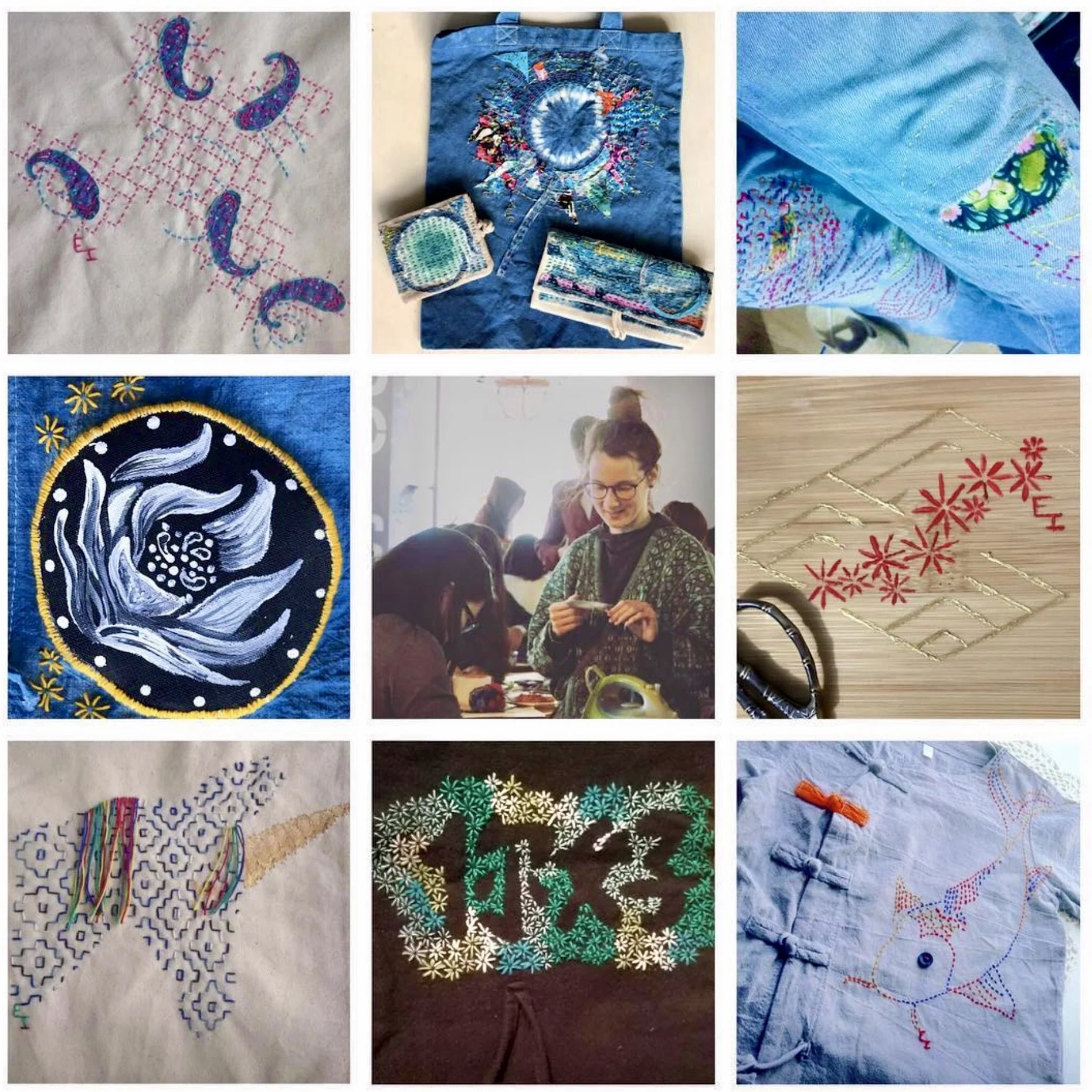
Emilie’s work in specialist Japanese sashiko is not decorative stitching laid onto cloth, but a practice of building structure through repetition, rhythm and repair. Working with needle and thread, she layers running stitches into the fabric, reinforcing, strengthening and quietly transforming it over time. Pattern emerges through process rather than imposition — stitched in, held within the cloth, and made integral to its life.
Beijing: Immersion, Language and the Conditions for Creativity
Living in Beijing for more than ten years — long enough for its rhythms to feel like a second home — she absorbed the city’s textures intimately. She speaks and reads Mandarin, a fluency that drew her into conversations, friendships and opportunities that shaped her not just as an artist, but as a person. Each chapter of her life taught her something precise about the emotional conditions required for creativity to flourish: softness, spaciousness, and the feeling of being seen.
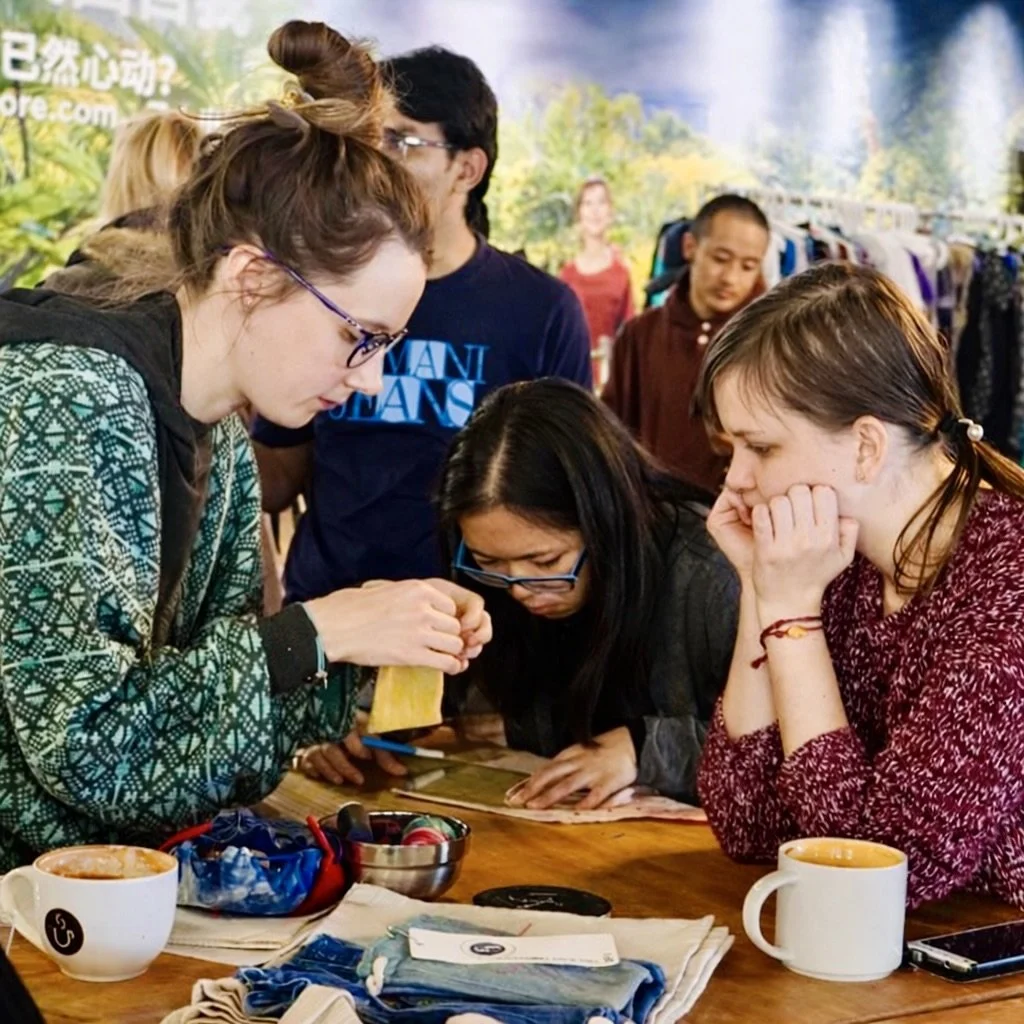
Emilie Ma teaching specialist Japanese Sashiko in Beijing, guiding each stitch with care as knowledge is passed hand to hand, slow, attentive and shared.
She has watched how people shrink in formal, intimidating rooms, and how they expand in spaces that feel warm, human and uncritical. “Creativity flows better where the surroundings are inspirational, visually stimulating,” she said, recalling how she would gently rearrange even the most rigid classroom. In Beijing she learned to curate small groups with intention — cushions, music, simple tools laid out with care — “just so people could relax enough to try.” Making, in her hands, is never performative; it is invitational.
Her time teaching English in Chinese high schools offered a stark contrast to the intimate teaching environments she instinctively cultivates. “Large classrooms felt intimidating,” she admitted — rows of forty teenagers, strict desks, and the pressure of scale. And yet the pupils astonished her. “They were like sponges,” she said. “Their attitude to learning was completely different to what I’d experienced at school.” She taught them not only English but also elements of British culture through music, films and everyday stories, all of which they absorbed with remarkable enthusiasm. “They had such a thirst for understanding,” she recalled fondly. One pupil even developed a strikingly authentic English accent — so natural that it caught Emilie off guard. “It was so impressive,” she said, smiling. Those years revealed something essential to her: curiosity, when met with generosity, can flourish anywhere — even in the most formal of rooms.
Beijing shaped her in countless subtle ways. For a year she worked in a contemporary art museum, documenting exhibitions, filming installations and collaborating with a small team who quickly felt like family. “There was no hierarchy,” she remembered. “Everyone was very comfortable in their role, and expertise was just handed out by anyone who had it.” They ate together, carried equipment together, and problem-solved long into the evening. That period taught her a tender truth: that creativity is rarely solitary. “It’s never just one person making something happen,” she said. “It’s the whole atmosphere you’re in.”
Craft travelled with her across continents. “I was always making something,” she told me. “Even as a kid, it was the tiny details I loved — the repetition, the absorption.” Jewellery design at university sharpened her eye for precision. Ceramics, lino, scratchboard, denim and indigo cotton deepened her feel for rhythm and resistance. Scratchboard, especially, captivated her: “I adored that tiny flick of white — it felt like drawing with light.”
But it was China’s everyday repair culture that most deeply imprinted itself on her. Repair was woven into the city without ceremony: tricycles announcing their services, shoes fixed curbside, older women knitting and stitching as naturally as breathing. In contrast, she felt Western tendencies toward disposability. Sashiko — the Japanese tradition of decorative reinforcement stitching — felt like a perfect bridge. “It’s repair, but also respect,” she explained. “Every stitch matters. Every stitch strengthens something.”
Some of her most defining shifts came through the quiet belief others placed in her. At school she was told her weak maths grades meant university was unlikely — but one person challenged that. “I definitely wouldn’t have done any of those things without their perspective of what I could achieve,” she reflected. That encouragement opened the door to her creative education and, eventually, her life abroad.
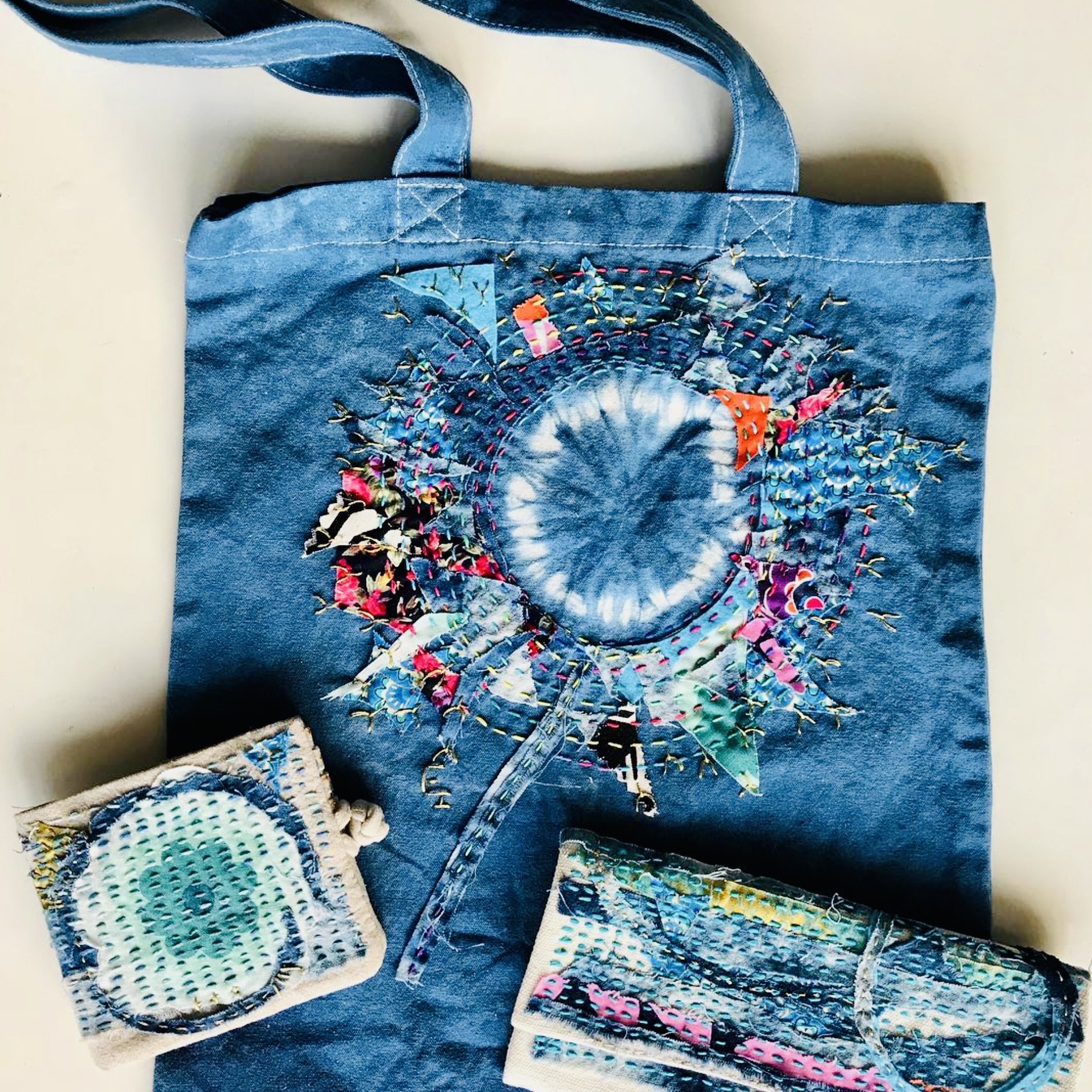
Emilie’s work brings together scrap fabrics through specialist Japanese sashiko, building texture and pattern through slow, repeated stitching until each piece feels quietly whole.
From Beijing Market Stall to Somerset Studio: Sashiko, Meaning and an Inner Sense of Enough
Years later, running her sashiko stall in a Beijing market with her newborn beside her, she experienced a moment of profound affirmation. A woman walked straight over, picked up an embroidered pouch, read the label, and bought it without hesitation. “I remember thinking — maybe I can do this. Maybe people really do see value in it.”
Today, settled in Somerset, Emilie’s practice feels anchored and distilled. She draws inspiration from the visual language of Chinese characters, sewing or painting words that hold emotional resonance. One of her favourites translates as Enough / Sufficient / Abundant. “That word reminds me that we all have enough inside us already,” she said. “All of us have such an ‘Abundance’ inside. I want my students to feel that — that every stitch makes a difference.”
She is equally thoughtful about honouring tradition. “Machine-printed sashiko designs look lovely,” she said, “but I worry the story gets lost. The labour, the purpose, the history — it’s easy for that to slip away.” For her, teaching sashiko is a way of keeping the lineage intact: “Every stitch is a connection to someone before you.”
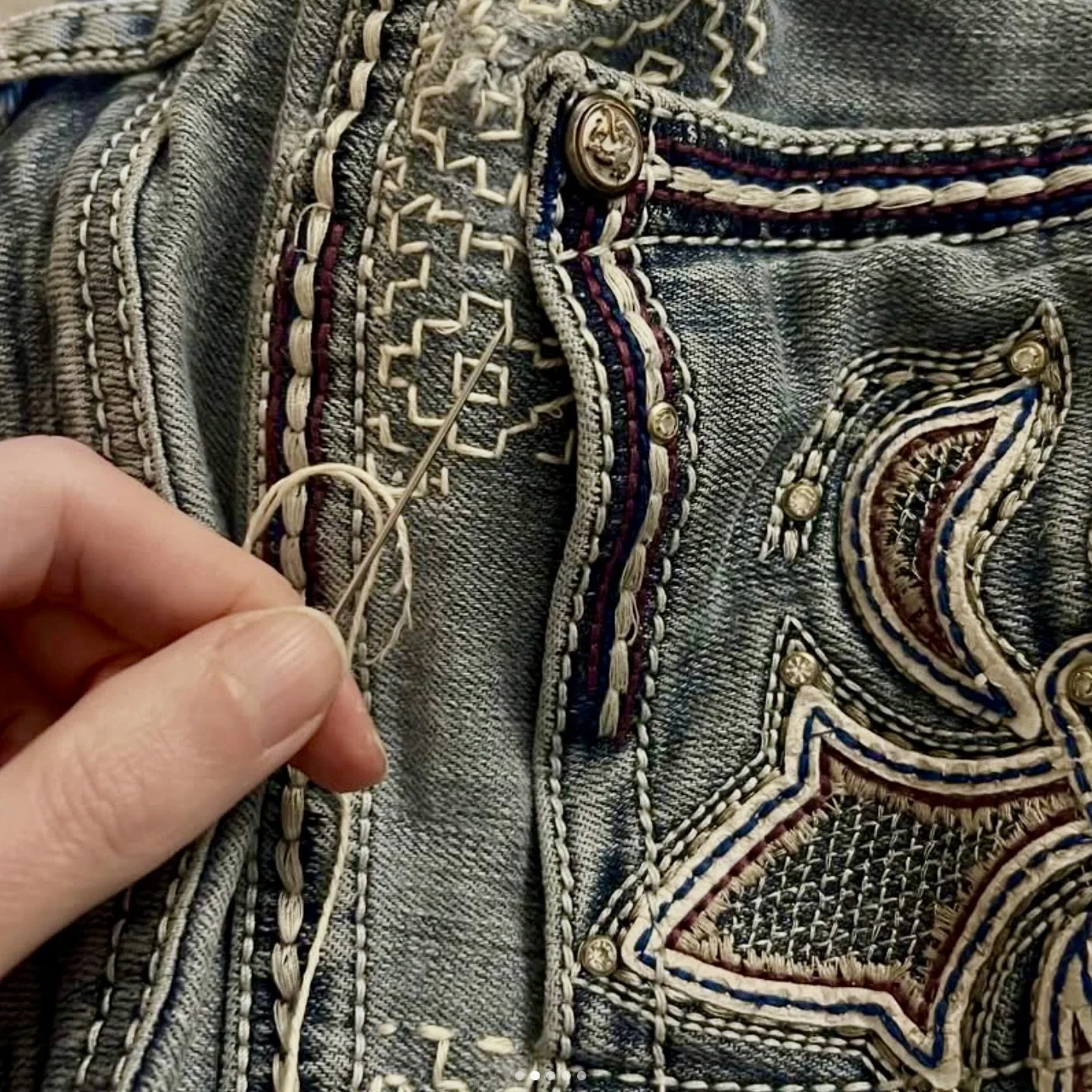
A close view of hand stitching in progress, where layered threads build pattern, structure and repair directly into the cloth through careful, deliberate work.
Here at Asterion & Co., Emilie will be leading Two Sashiko Workshops: one dedicated to embellishing denim — the collar or pocket of a well-worn jacket — and another on visible mending, allowing guests to bring cherished garments back into meaningful circulation. Both sessions reflect what she holds most dear: the belief that renewal is possible, that beauty can emerge from care, and that creativity thrives in warm, generous spaces. “Repair is hopeful,” she said. “It says something isn’t finished yet.”
We ended our conversation and stepped outside for a quick look at the garden, afternoon rain beginning to fall in soft, scattered drops. In that small moment, it became completely clear why Emilie belongs within the Asterion family. Her work is thoughtful and tender, grounded in the idea that repairing and remaking are not just acts of craft, but ways of caring — for the fabric in front of us, and for ourselves.
Join Emilie at The Old Vicarage for her upcoming Sashiko workshops — a chance to slow down, stitch with intention, and rediscover the satisfaction of renewing something you love.
Book the workshops here:
Wednesday 8th July 2026: Stitching the Everyday: Japanese Sashiko as Surface Embellishment.
Wednesday 21st October 2026: Mending with Meaning: Japanese Sashiko for Structural Repair.