Stitching Time Back into Cloth: Sashiko, Denim, and the Philosophy of Repair
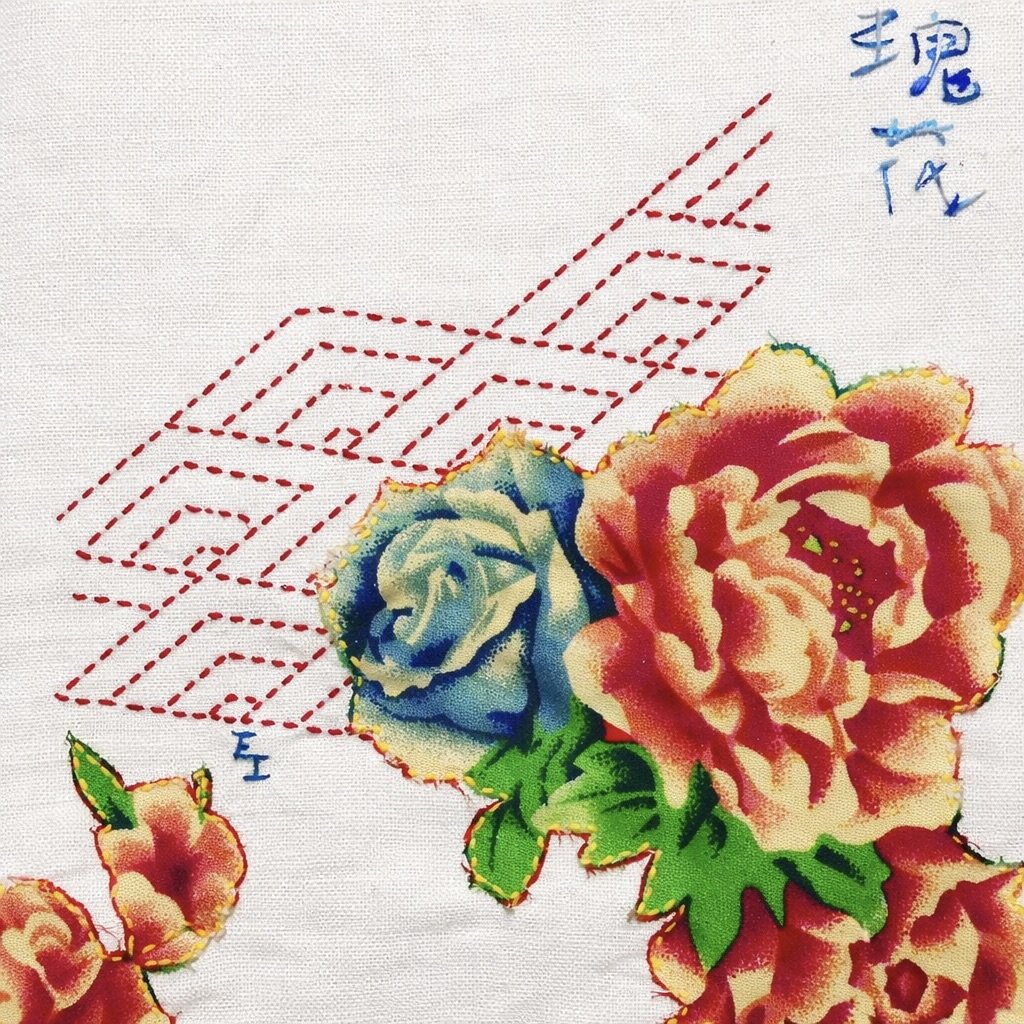
Embroidered blooms and measured lines - Sashiko artist, Emily Ma’s quiet study in pattern, process and mark-making, signed with her EI monogram.
Sashiko was not a tradition I had encountered before starting Asterion & Co., or before deliberately stepping beyond my own artistic reference points. It emerged through early conversations with artists and artisans — about repair, cloth and the intelligence embedded in everyday objects — and it stayed with me. What struck me immediately was not its visual language, but its logic: a system of making where stitch mattered structurally; where thread did not merely adorn, but reinforced; where the act of working slowed the maker and sharpened attention.
Repair as a Way of Life
In an age shaped by speed, novelty and planned obsolescence, there is something quietly radical about choosing to mend. Not as a stop-gap, nor as a cost-saving necessity, but as a deliberate, thoughtful act — one that asks for time, attention and care. Japanese Sashiko, with its measured running stitches and disciplined repetition, belongs to a lineage where repair is not an afterthought, but a way of life.
Sashiko emerged in rural Japan during the late Edo period, becoming more widespread through the early Meiji era — broadly from the late eighteenth into the nineteenth century. It developed in farming and fishing communities where cloth was scarce, winters were harsh, and clothing was expected to endure years of physical labour. Textiles were not easily replaced. They were strengthened, insulated and repaired repeatedly, most often within the home.
The garments worked on were homespun fabrics: hemp and ramie in earlier periods, and later cotton, which remained precious well into the nineteenth century. Ramie, a plant fibre made from the stalks of a nettle-like plant native to East Asia, had been cultivated for thousands of years and was prized for its strength and resilience.
These cloths were often indigo-dyed, using colour drawn from fermented plant leaves — prized not only for its depth of blue, but for its durability, antibacterial qualities and ease of re-dyeing.
Layers were built up where wear was greatest, stitches added to reinforce stress points, damage addressed before it became failure. Clothing became a visible record of use and care, surfaces marked by labour and attention over time.
Knowledge Passed Hand to Hand
Crucially, this knowledge did not sit within institutions or academies. It passed from hand to hand, within households, across generations. Techniques were learned by watching, by doing, by living with cloth long enough to understand where it weakens and how it responds to intervention. Sashiko was not decorative in its origins; it was pragmatic, rhythmic and quietly inventive. Any beauty that emerged did so incidentally — born of repetition and necessity rather than aesthetic intention.
Today, when Sashiko is encountered outside Japan, it is often admired for its graphic clarity: the geometry of pale thread against deep indigo, the calm order of repeated motifs. Yet to understand the practice fully is to recognise that those stitches are records of intent. They speak of patience, of thrift in its truest sense, and of a mindset that values longevity over replacement.
Heritage-Inspired Learning
Within the context of Asterion & Co.’s heritage-inspired learning approach, this matters deeply. The aim is not to romanticise the past, but to understand how inherited practices can inform contemporary choices — how craft can offer frameworks for living as well as making. Sashiko does this with clarity. It shows us that repair is not a sign of failure, but of stewardship; that care is something practised, not proclaimed.
The discipline of Sashiko asks us to stay with a problem rather than replace it, to look closely before acting, and to value time spent doing something well. These ideas sit naturally within Asterion & Co.’s wider commitment to learning that is grounded, purposeful and shaped by doing.
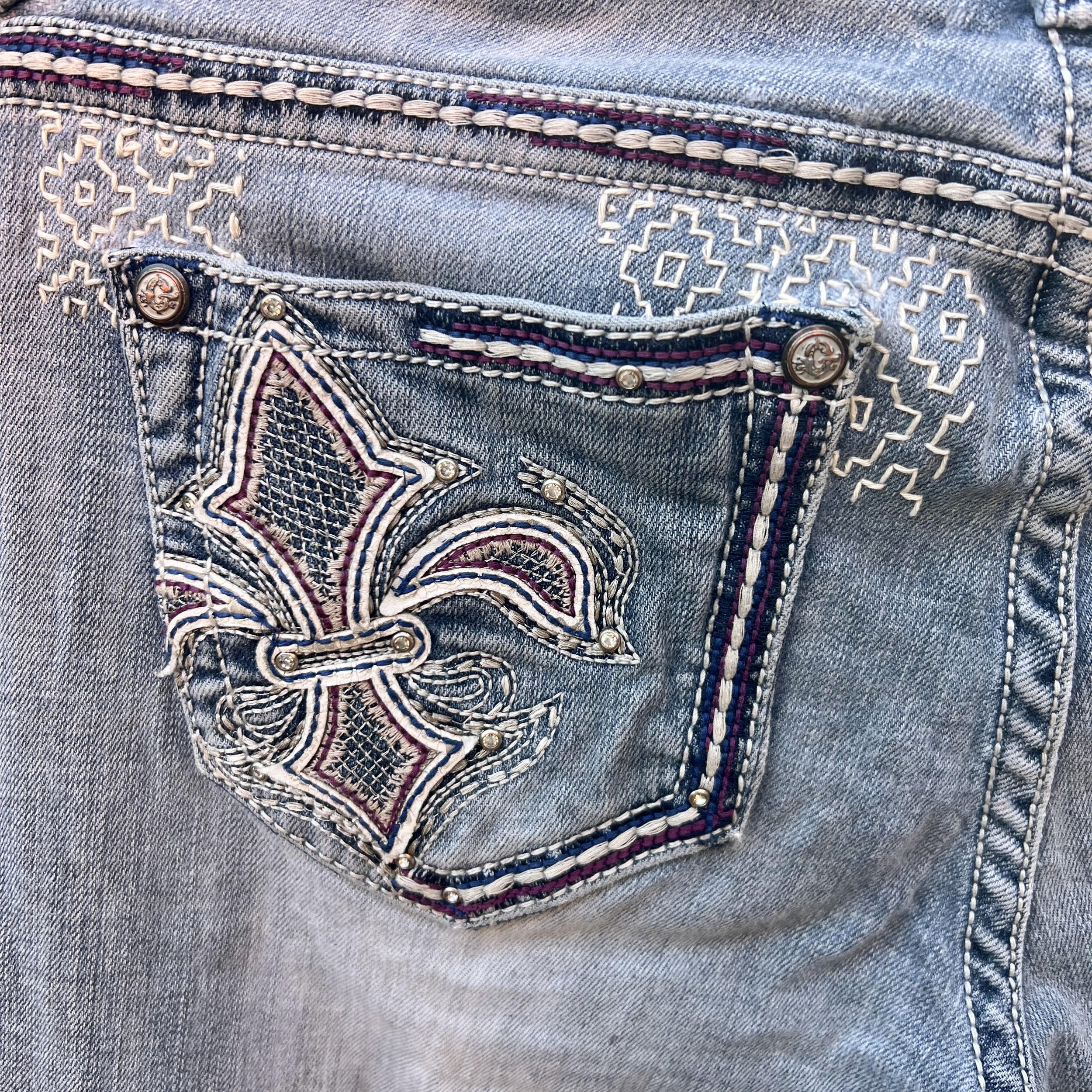
Where two workwear traditions meet: denim’s endurance, strengthened and made visible through stitch.
When Sashiko Meets Denim
Denim enters this story much later. Its roots lie in Europe, in robust working cloths produced in France and Italy from the seventeenth century onwards. One lineage traces to serge de Nîmes, a hard-wearing twill woven in southern France; another to sturdy cotton fabrics associated with the port city of Genoa, produced for sailors and dock workers. By the late nineteenth century, these textiles had been industrialised and widely adopted as workwear, particularly in the United States, where denim became synonymous with labour, endurance and use.
Denim arrives in Japan toward the end of that century, but it is in the decades following the Second World War that Japanese makers begin to develop a distinctive relationship with indigo denim — one grounded in close material study, wear patterns and longevity. The pairing of Sashiko stitching with denim is therefore not ancient, but it is deeply logical: a meeting of two workwear traditions shaped by durability, repair and daily use.
By the mid-twentieth century, Sashiko was increasingly being applied to denim garments as they aged and failed — not as an attempt to recreate the past, but as a continuation of the same thinking. The stitch moved from hemp and cotton into denim — a different fabric, worn in different ways — carrying its purpose with it.
What matters here is not historical purity of fabric but staying true to the original idea: strengthening what already exists, extending its life, and allowing wear to be seen rather than hidden.
Two Ways of Working With Cloth
The two embroidery workshops that will take place at Asterion & Co., both working with denim, should be understood as two expressions of the same underlying philosophy. They differ in intent and mindset, but not in values.
In the embellishment workshop, stitching becomes a way of marking cloth with intention. Patterns may be planned or allowed to evolve, responding to the fabric beneath. Here, Sashiko’s visual language is explored as a form of expression, while still honouring its disciplined structure. Embellishment is not excess; it is considered placement, rhythm and restraint. The mindset is cumulative, but careful — attentive to balance, wearability and longevity.
The mending workshop, by contrast, begins with damage. A worn knee, a frayed pocket, a thinning seam. Rather than disguising these signs of use, Sashiko invites engagement with them. Stitching strengthens weak points, extends life, and in doing so acknowledges the garment’s history. The mindset here is responsive rather than assertive. The cloth leads; the stitch follows.
Seen side by side, these two approaches reveal how closely repair and adornment sit together. To embellish thoughtfully is already to commit to longevity. To mend visibly is to accept that beauty can lie in honesty and care.
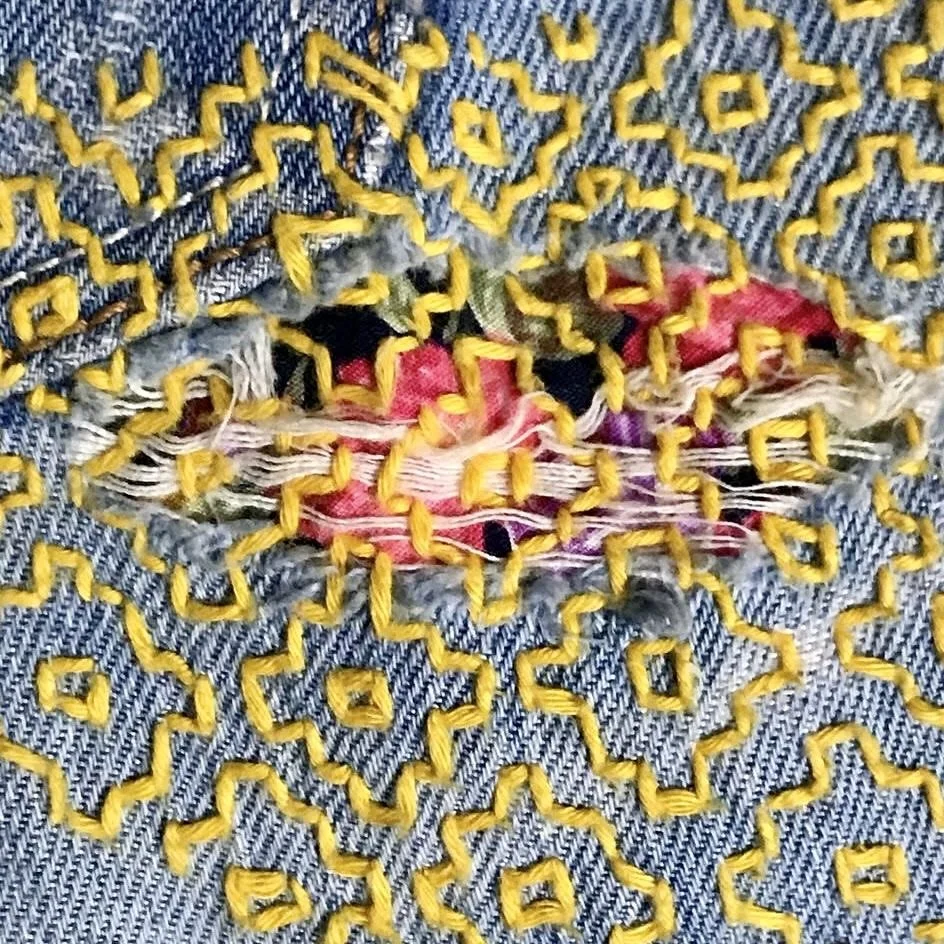
A denim tear held open, then strengthened — cloth and stitch in active conversation.
Learning to Mend, Learning to See
Denim is a particularly fitting ground for this work. Like the indigo cloths of rural Japanese workwear, it resists and responds to stress, recording wear honestly and rewarding reinforcement. Its cultural associations — from utility to rebellion to everyday staple — make it familiar, accessible and quietly democratic. Almost everyone owns a pair of jeans; many have a favourite they return to again and again, though fewer consider repair as part of how that care might be expressed.
By stitching into denim, participants are invited to reconsider what is already present in their wardrobes. The material asks for firmness of hand and consistency of stitch. Over time, the dialogue between thread and cloth deepens. The garment becomes not just something worn, but something tended.
Our Upcoming Workshops
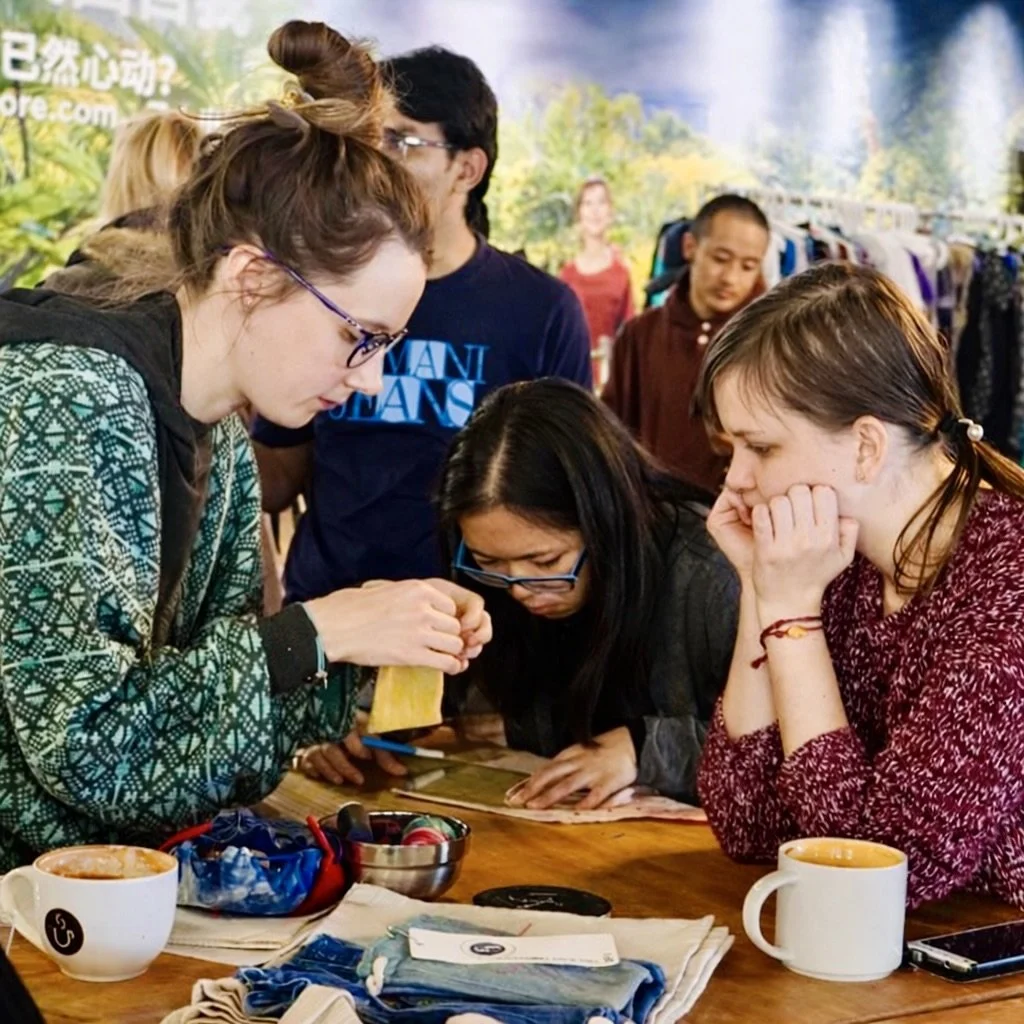
Emilie teaching the quiet discipline of stitch in the hum of a Beijing market.
These workshops will be led by Emilie Ma, a Cornish-born, multi-disciplinary artist whose practice spans embroidery, visible mending, scratchboard and jewellery design. Drawing on years spent living and working in China, alongside the realities of making within the rhythms of motherhood and market life, Emilie brings a sensitivity to pace and process that sits naturally within the discipline of Sashiko. Her approach is not hurried, nor performative. It reflects a lived understanding of repair as something practical, social and quietly transformative.
What participants will encounter is not simply a technique, but an invitation to see differently: to notice how fabric behaves, how repetition builds strength, how small interventions add up over time. These are lessons that extend beyond embroidery, touching on broader questions of consumption, care and responsibility.
Sashiko reminds us that repair is not a detour, but a continuation. That to work with our hands is to participate in a lineage of problem-solving and attention. That time, when stitched carefully into cloth, becomes visible — and valuable.
At Asterion & Co., these workshops sit comfortably within a wider commitment to regeneration, craftsmanship and quiet accomplishment. They offer a way to slow down, to work deliberately, and to leave with something strengthened rather than replaced. In a world that often rewards speed and novelty, there is enduring power in learning how to mend — and in choosing to do so beautifully.