In conversation with Clare Mahoney, Ceramic Artist and Botanical Casting Tutor
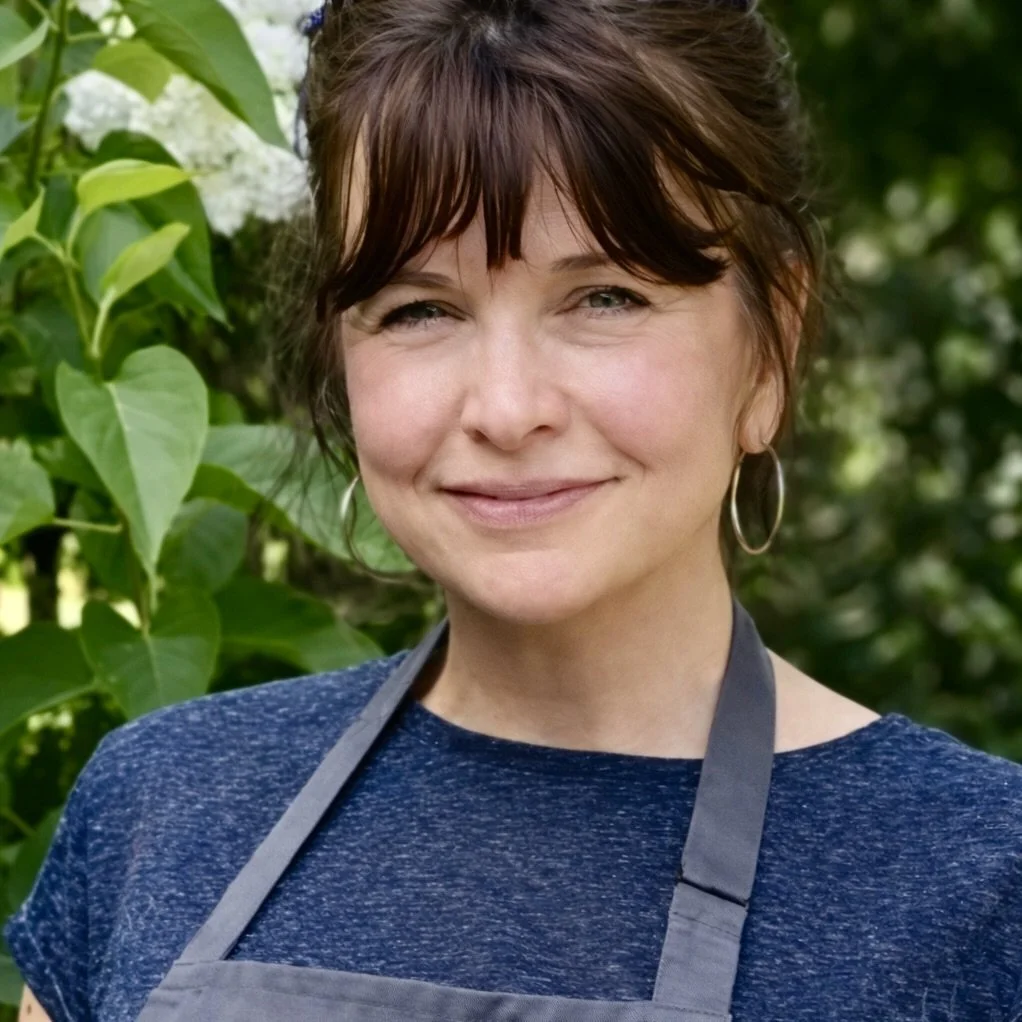
Clare Mahoney — attentive to nature, and to what reveals itself when you slow down.
Clare Mahoney was introduced with botanical casting in mind through her contemporary — and fellow artist — Rowena Mayell. The two have been firm friends since meeting as undergraduates at the Glasgow School of Art, a bond formed early and sustained through shared practice, values and mutual regard. As so often happens in the world of making, the introduction revealed itself to be threaded back through time. Clare’s work, it turned out, was already familiar: a set of porcelain pebbles delicately printed with cobalt blue botanical silhouettes, discovered at SEED in Frome.
That initial recognition came through material presence. Smooth, weighty and satisfying in the hand, the pieces felt less like objects made than objects discovered. They were loved immediately and chosen as a birthday gift for my sister. Only later did the line connect — the hand admired, the sensibility recognised, already known. That quiet attentiveness, so evident in the objects themselves, is not limited to Clare’s work. It is embodied when meeting her in person.
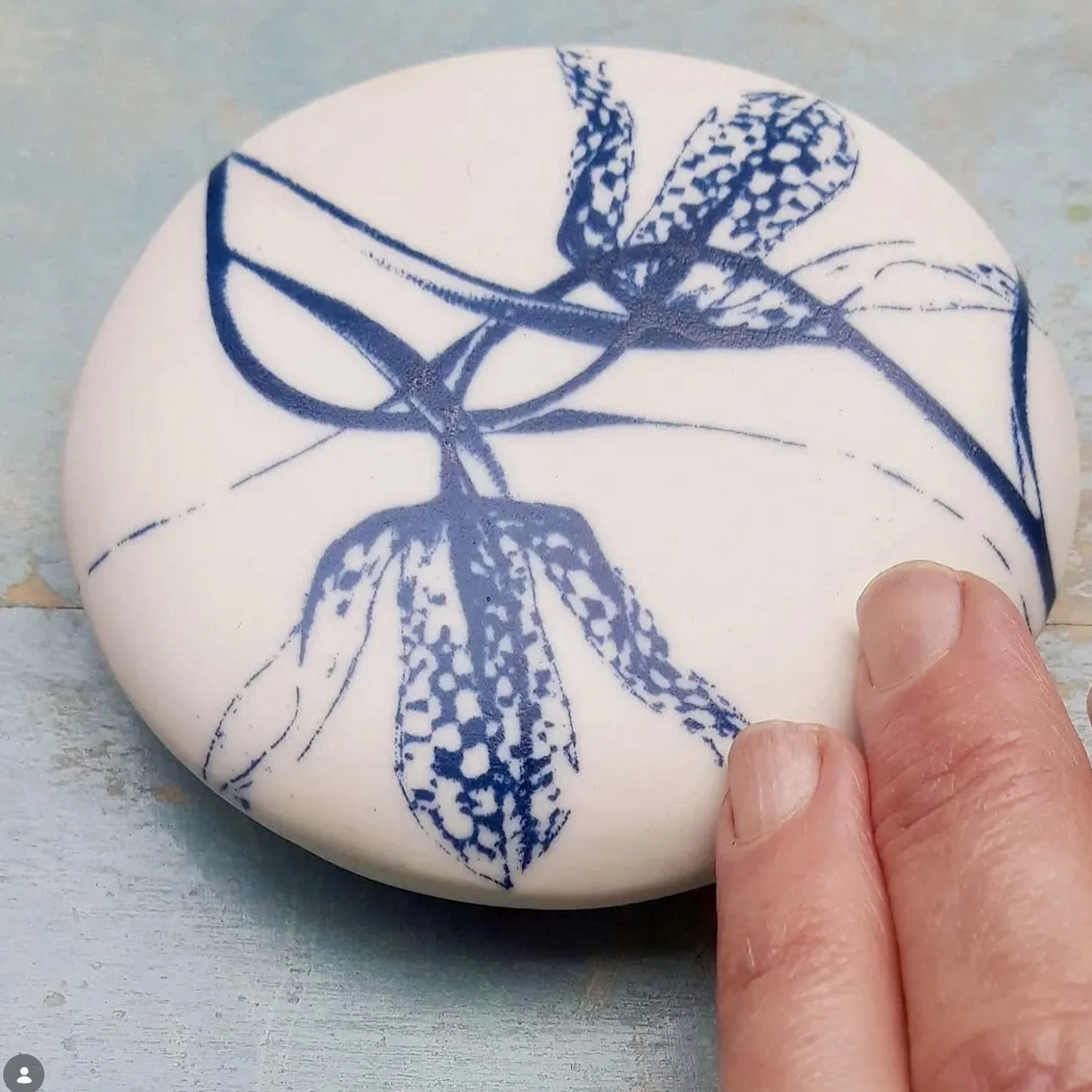
Clare’s porcelain botanical pebbles are works where imagery is not applied after the fact but formed into the work from the outset. Working initially on flat clay, she builds up printed slip-transfer layers before shaping the pieces in press moulds. The botanical impression is fired into the porcelain rather than sitting on the surface — absorbed, held, made integral.
Meeting and making as connection
There are some people who change a space simply by entering it — not through volume or performance, but by the atmosphere they bring with them. Clare is one of those people. Even helping to unload her car, full of boxes of tools and materials in preparation for a practical session, calm seems to settle around her: a quiet steadiness, an attention that does not rush, and a sense — felt rather than announced — that this is a space where it is safe to try.
Our first meeting took place at Asterion & Co.’s home in Leigh-on-Mendip last October, unfolding through conversation as we wandered through the grounds. Time was spent walking borders, paths and wild edges — noticing, exchanging, and talking about which forms translate well through the casting process. The garden revealed itself as a shared resource: seedheads, stems, overlooked plants waiting to be seen. It is a space rich in material and possibility, one that will continue to be drawn upon in upcoming workshops. For Clare, it echoed something fundamental to her practice — the belief that creativity begins when people feel sufficiently grounded to slow down, look closely, and re-enter their own attention.
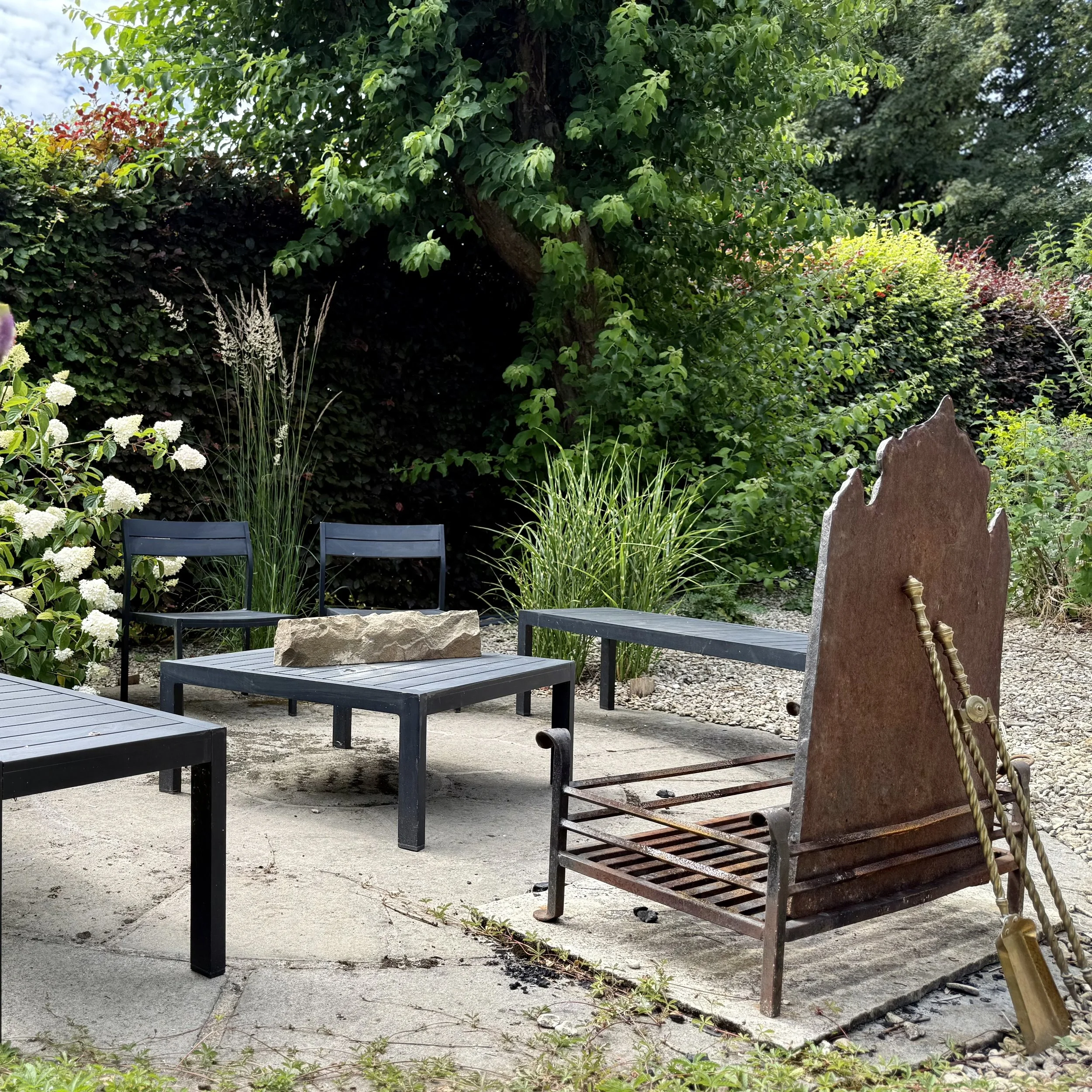
Grasses, seedheads and overlooked plants from The Old Vicarage garden, gathered and re-seen as source material.
That belief was felt most clearly as we moved from the garden to the classroom and making began in the casting session — an introduction to the process itself. Approaching a new artistic method often carries a quiet tension: the fear of doing it “wrong”. Here, that anxiety barely surfaced. The practice proved deeply relaxing and meditative. Clare’s manner sets the tone: unhurried, attentive, encouraging without instruction ever tipping into correction. Guidance arrives in the form of small, well-timed observations — a suggestion here, a reassurance there — and, almost without noticing, ease takes over.
Under Clare’s guidance, botanical casting becomes a form of quiet concentration — absorbing without being demanding, structured without being rigid. As a pupil, you feel free to arrive exactly as you are, in clothes that can bear the occasional splatter of clay or plaster. That, perhaps, is her greatest skill: not only technical knowledge, but the ability to create the conditions in which other people’s confidence can surface.
The process itself balances precision with surrender: the plant leads, the material responds. There is always an element of risk, followed by a moment of revelation. “When you set down the rolling pin, pull back the cloth, tease out the plant material and it’s just there,” Clare says, “you’ve captured that moment.”
Unlike much ceramic work, which unfolds slowly across firings and waits, casting offers immediacy. Plaster is poured; a chemical reaction generates heat as it rapidly sets; and within the hour the work is revealed. Clare never tires of it. Nature, she says simply, “does it for me.”
For Clare, this is not preservation for its own sake. Botanical casting is relational — a way of encouraging people to look longer. Often the plants are humble ones: grasses, roadside weeds, overlooked fragments of the everyday landscape. Through the act of casting, these small lives are given attention. In that pause, something shifts. What participants take away is not only a finished piece, but a recalibrated way of seeing.
Her artistic œuvre moves between distinct but closely related strands of practice: botanical casting, intimate porcelain objects, and larger vessel forms built up from moulded botanical elements. It is, however, botanical casting that sits at the heart of Clare’s teaching and collaborative work.
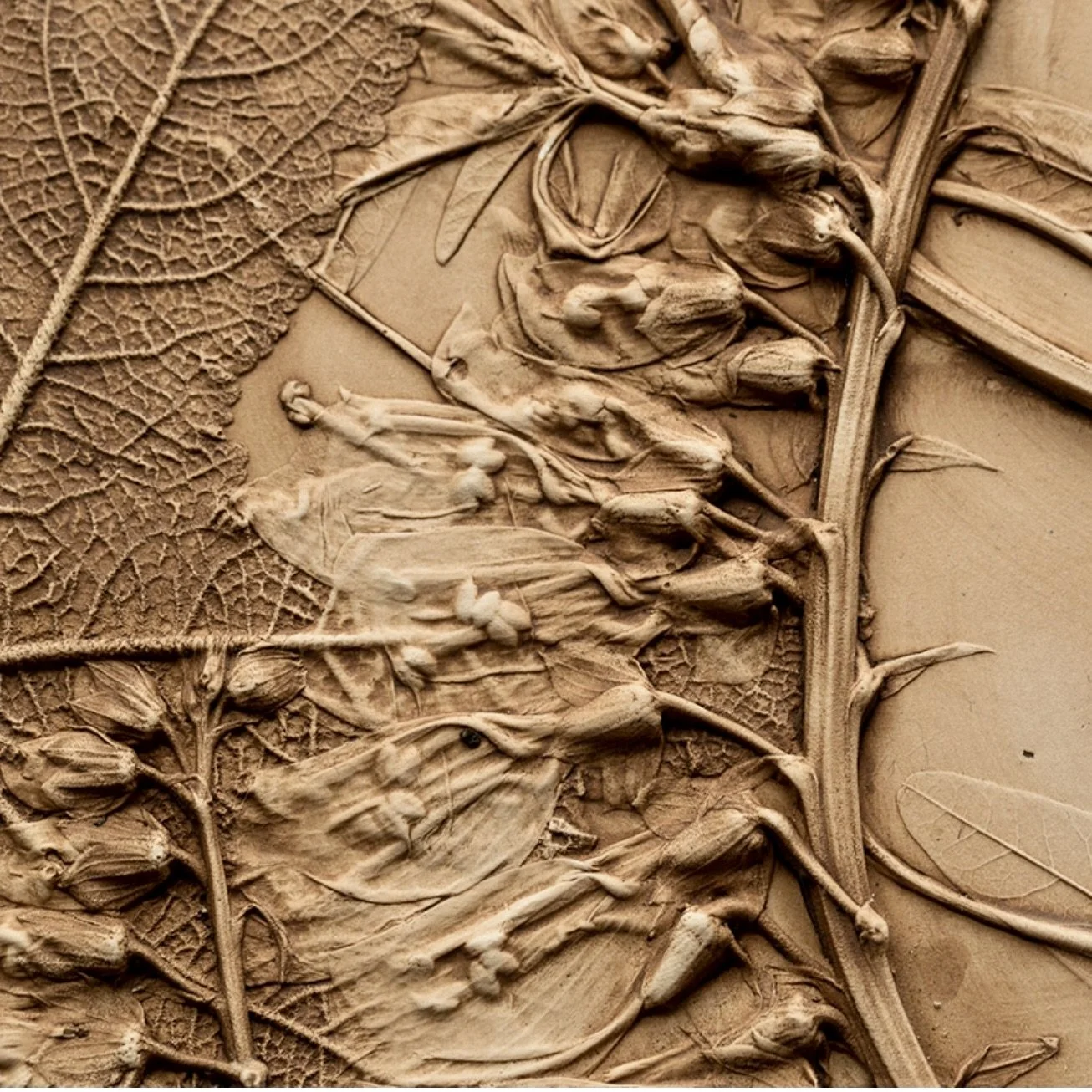
Botanical forms, momentarily held in clay, then re-emerging in plaster with mesmerising clarity.
Teaching as integral to her artistic practice
Clare speaks openly about being severely dyslexic and attending a specialist school as a child — experiences that underpin her commitment to equality and access in education.
Her wider community work, including a period as a lecturer at City of Bristol College, reflects a long-standing commitment to teaching both children and adults with special educational needs. Sessions may be one-to-one, in small groups within her own studio, or embedded within wider collaborative projects and institutions. Across all settings, the principle remains the same: patience, respect for difference, and an understanding that everyone brings their own rhythm and way of seeing the world. Clare finds this work endlessly instructive, and it continues to feed back into her studio practice in subtle but lasting ways.
She speaks about teaching not as instruction, but as restoration. “I’m passionate about removing the boundaries between the person and their creative self,” she explains. If people feel safe in a space, she believes, they relax into the medium. From there, something quieter and more powerful can happen: a creative voice reappears that may have been dormant for years. “Everyone makes before they speak,” she adds — a simple observation that carries the weight of lived experience.
That steadiness, however, is balanced by an awareness of the emotional labour involved in teaching. While she finds it profoundly rewarding, it can also be exhausting. To sustain herself, Clare returns to solitude: days in the studio with the phone off, unreachable. “That’s the honest answer.” The studio becomes a place of equilibrium — not only where objects are made, but where energy is restored.
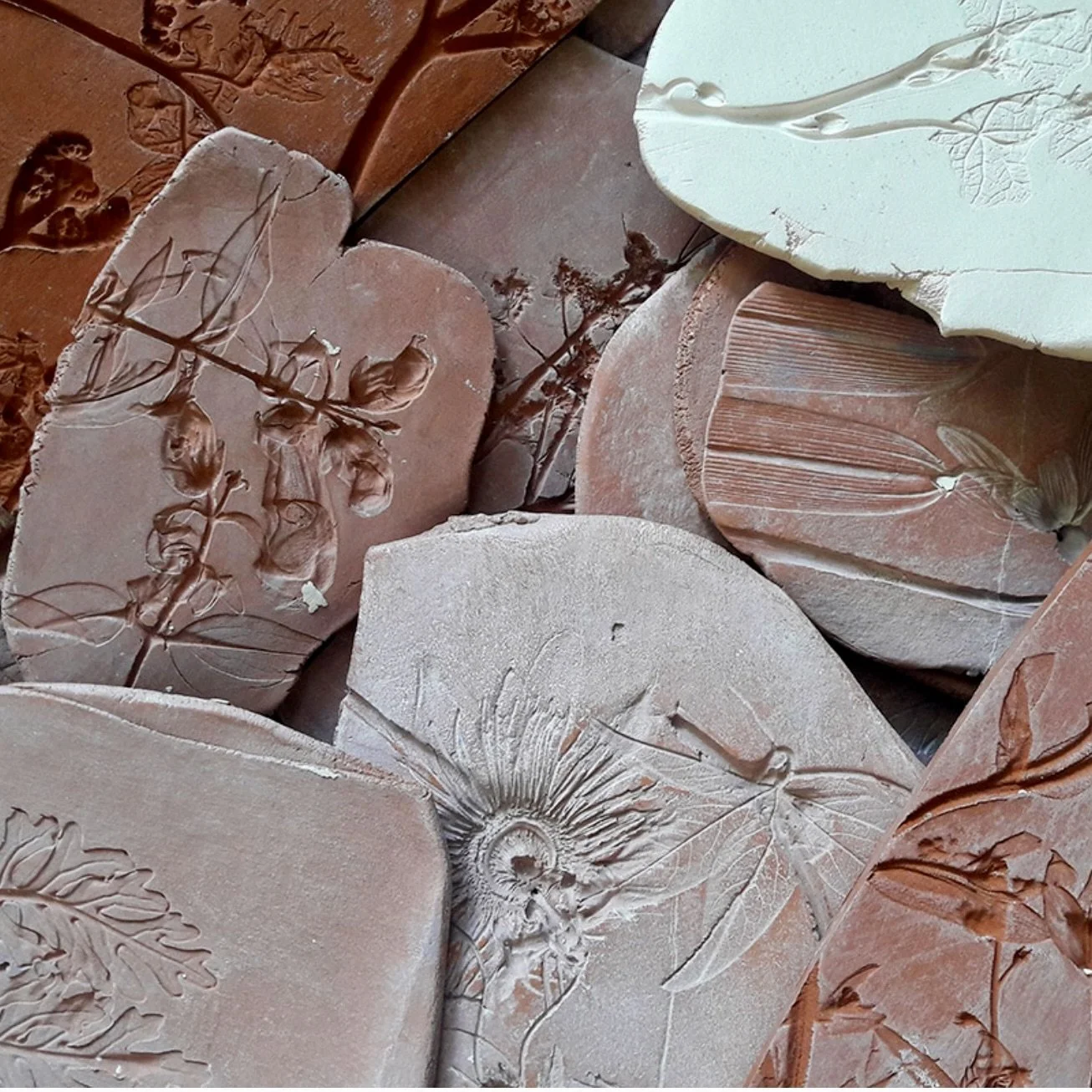
Fragments of clay from past casting sessions, bearing the quiet record of process and touch.
This sensitivity to balance is inseparable from Clare’s relationship with materials — a relationship shaped by both instinct and deep training. Clay, she says, is honest. It records every tension of the hand, every hesitation and correction — and every moment of trust. “You can’t hide.” In a world of surfaces designed to conceal, clay insists on presence. Clare’s confidence with this honesty is underpinned by years of rigorous study, including an MA in Ceramics at UWIC Cardiff, where technical discipline and conceptual thinking were brought into close alignment. The result is a practice that is both materially fluent and quietly assured.
That balance between community and solitude surfaced again in Clare’s involvement with an arts initiative supported by the Jenner Trust. Working alongside a group of eleven artists, she responded to a site-specific brief and helped run workshops that took participants into neighbourhood schools to make maquettes and talk about emotion, place and artistic process. The piece she made for the culminating show was deeply personal, and she chose not to sell it — feeling it needed to remain with her rather than be sent out into the world.
Standing in good company
Art college, she says — after earlier experiences of schooling that were challenging — was where she found her tribe. “First day — never looked back.” The resilience required to be an artist — to persist with ideas others may not immediately recognise, to take critique — was shaped there. That determination still guides her hands today. She works incrementally, “a bit like a scientist”, responding carefully to what each piece asks of her next. Always moving forward, and attentive to those she can meaningfully connect with.
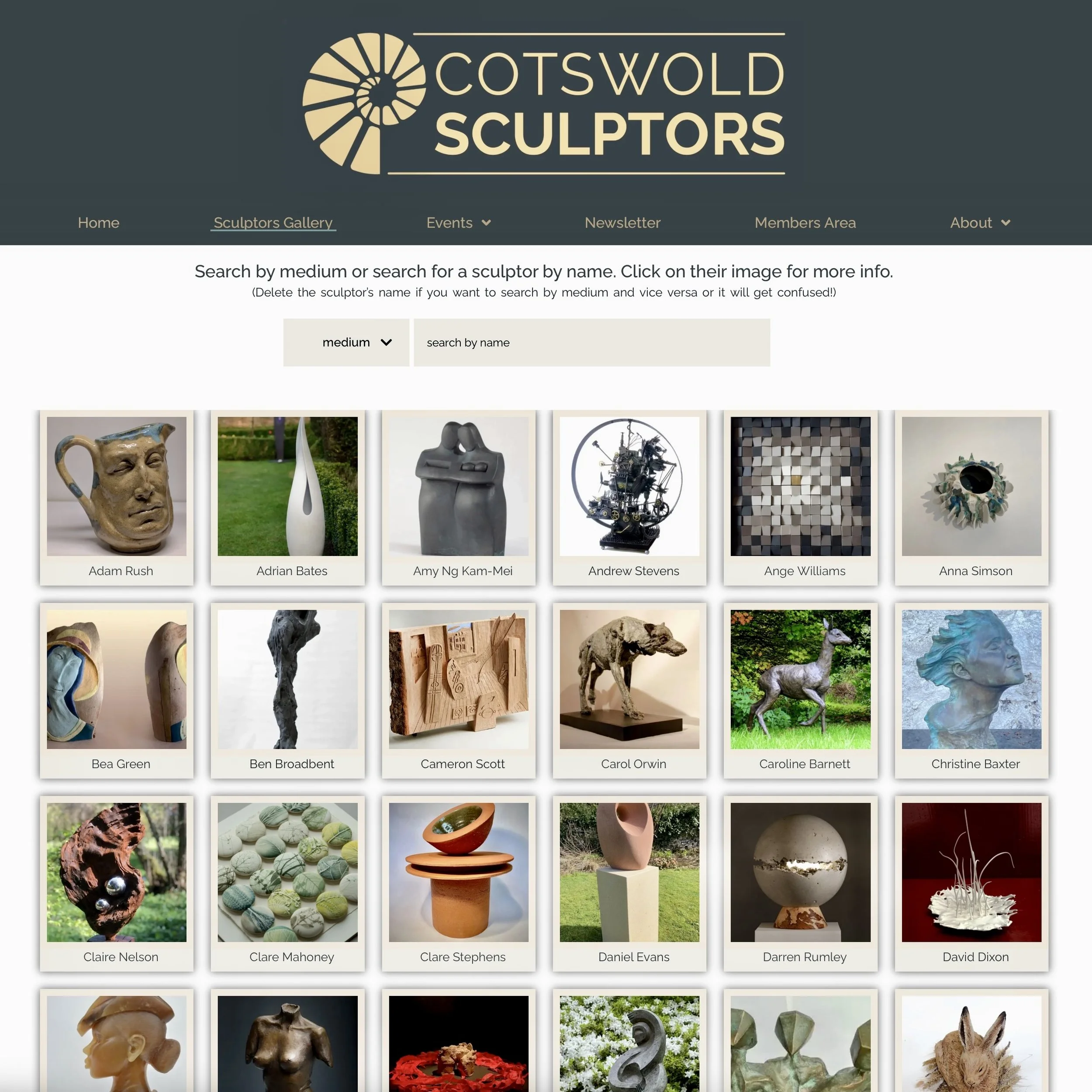
Part of The Cotswold Sculptors Association — an established community of nearly one hundred sculptors, and a context in which Clare’s work sits confidently among peers.
Clare is an active member of The Cotswold Sculptors Association, valuing the friendship and quiet encouragement that professional communities can offer. Ceramics can be an isolating profession, and Clare speaks of practice as a vocation rather than a job — something that requires support structures to endure. Kiln firings fail. Deadlines arrive. Confidence wobbles. Community keeps you on the course.
“The Association is important to me,” she says. “It’s a source of camaraderie and has led to joint shows with fellow members whose work and approach resonate deeply with my own.”
That instinctive understanding of people also shapes how Clare chooses who to work with. She does not rely on formal criteria. She meets someone, spends time with them, and listens to her gut. If she leaves a conversation feeling calm and open, she knows the collaboration will be nourishing. If she feels anxious or senses a need to perform, she steps away. That instinctive alignment is precisely what allows those she teaches to be held within the same sense of care and attentiveness.
Accomplishment as an artist
Clare’s CV — spanning exhibitions, numerous awards, residencies and community-based projects — is extensive, but more striking is its continuity. Over more than three decades, her practice has unfolded with remarkable steadiness: a sustained commitment to making, teaching and engagement rather than a career defined by peaks or phases.
When speaking about accomplishment, Clare is disarmingly clear. She never had a plan B. She never wanted to do anything other than be an artist — but it also had to be a practice she could live with and live from. Success, for her, is measured quietly: the respect of peers, and making work she is pleased to stand next to.
Integrity runs through every decision she makes. Clare resists the pressure toward speed and scale by working at a pace that feels sustainable — producing only what allows the work to remain true. Teaching provides balance. Small multiples allow care. She avoids chasing what she calls the “hungry beast”.
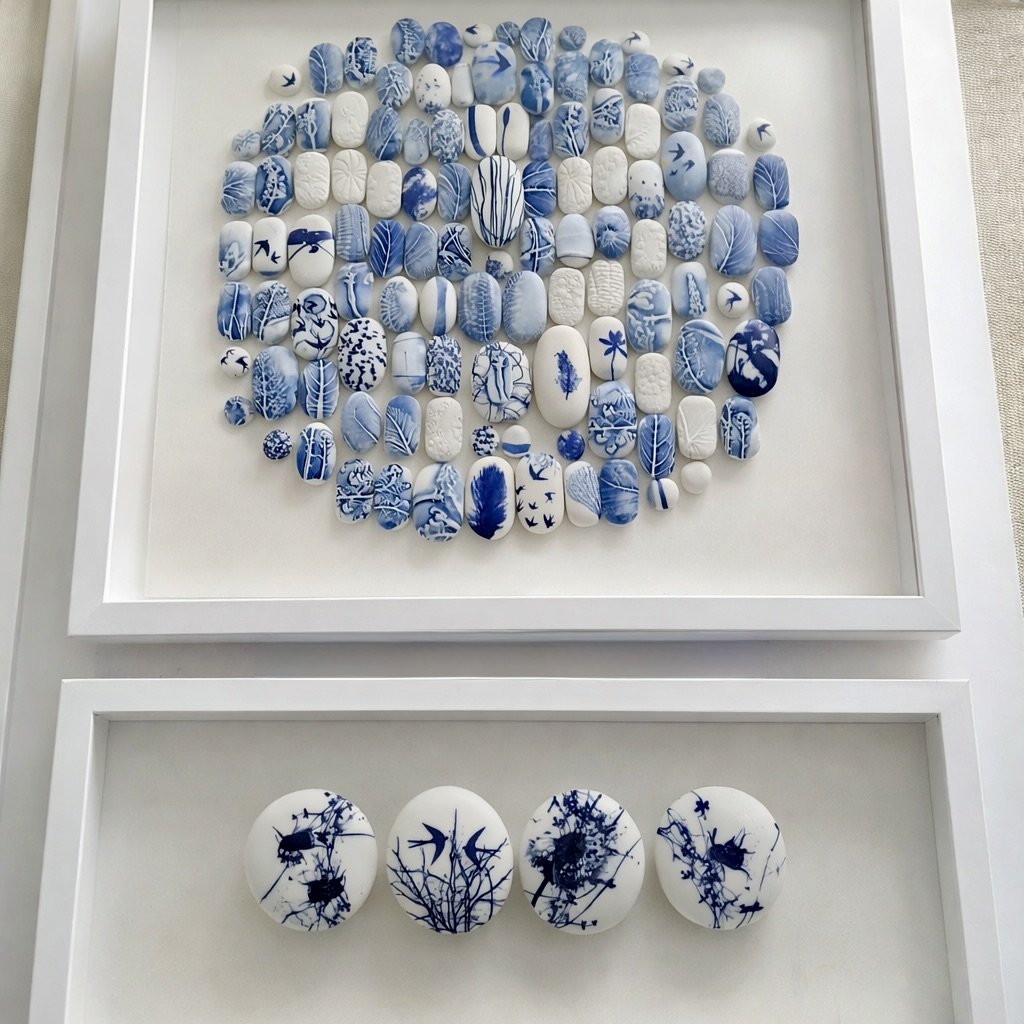
Porcelain botanical pebbles, shown en masse as part of a commissioned work — individual pieces gathering into something quietly powerful.
Fragility and resilience, held in tension
At the close of the conversation, with many joint exhibitions already behind her, Clare reflects that a solo show may come one day — but she is in no rush. “I would love a solo show at some point,” she says, “but it might be in ten years’ time — I could be in my eighties. I’m not climbing desperately towards that point. What I do know is that I’ll die in the saddle.” There is a smile in her voice — the quiet certainty of someone for whom making is not a phase, but a lifelong commitment.
The idea of a solo show carries a quiet charge. Clare’s individual works already hold their own within a show settings, but when brought together they suggest something more immersive — a depth and coherence that invites sustained attention. Asked whether such a moment might bring pressure to scale the work, she pauses before answering. “Probably, yes,” she says. “I’d want all the work to sit together, more like an installation — but more importantly, I’d want people to have an engulfing sensation. A feeling of fragility and resilience, and the tension held between them.”
This quiet thesis of Clare’s practice — that something can be both fragile and resilient — is encountered again and again in her work: in the porcelain pebble held in the hand; in the botanical cast lifted from plaster; and in the calm, generous spaces she creates for others to make. Places where delicacy is honoured, strength is built slowly, and both are allowed to coexist.
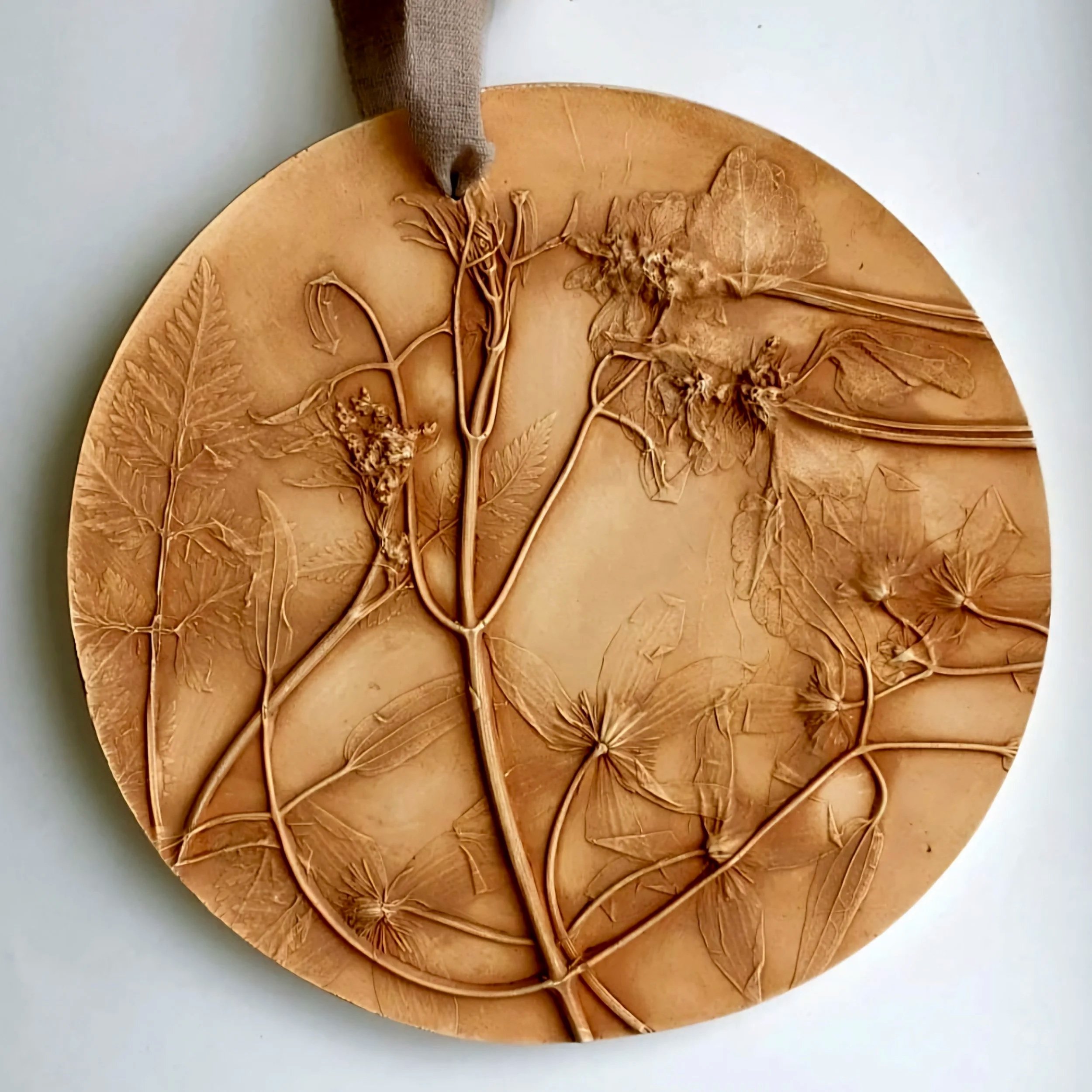
A finished botanical plaster cast, created during the workshop — one of the two pieces guests will take home.
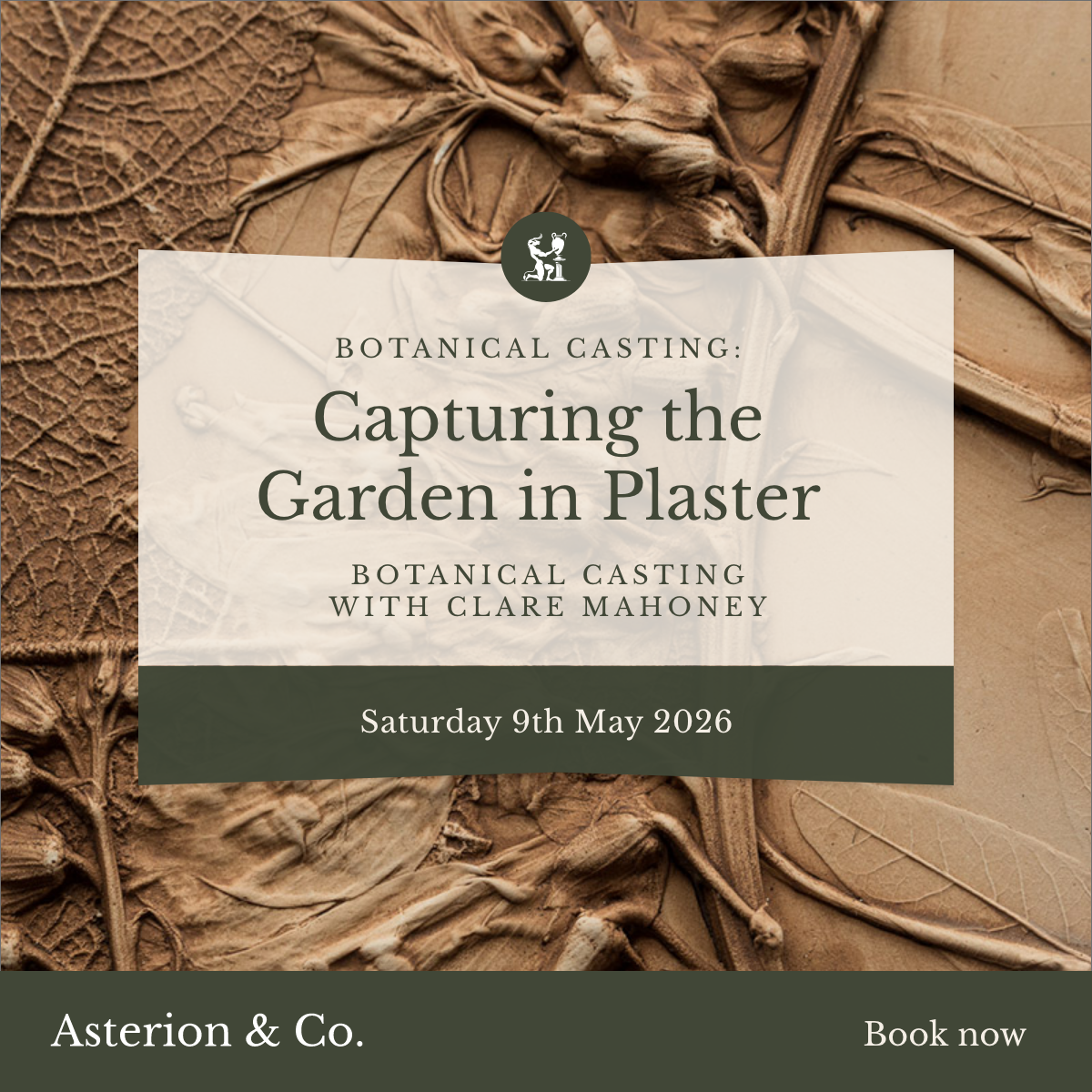
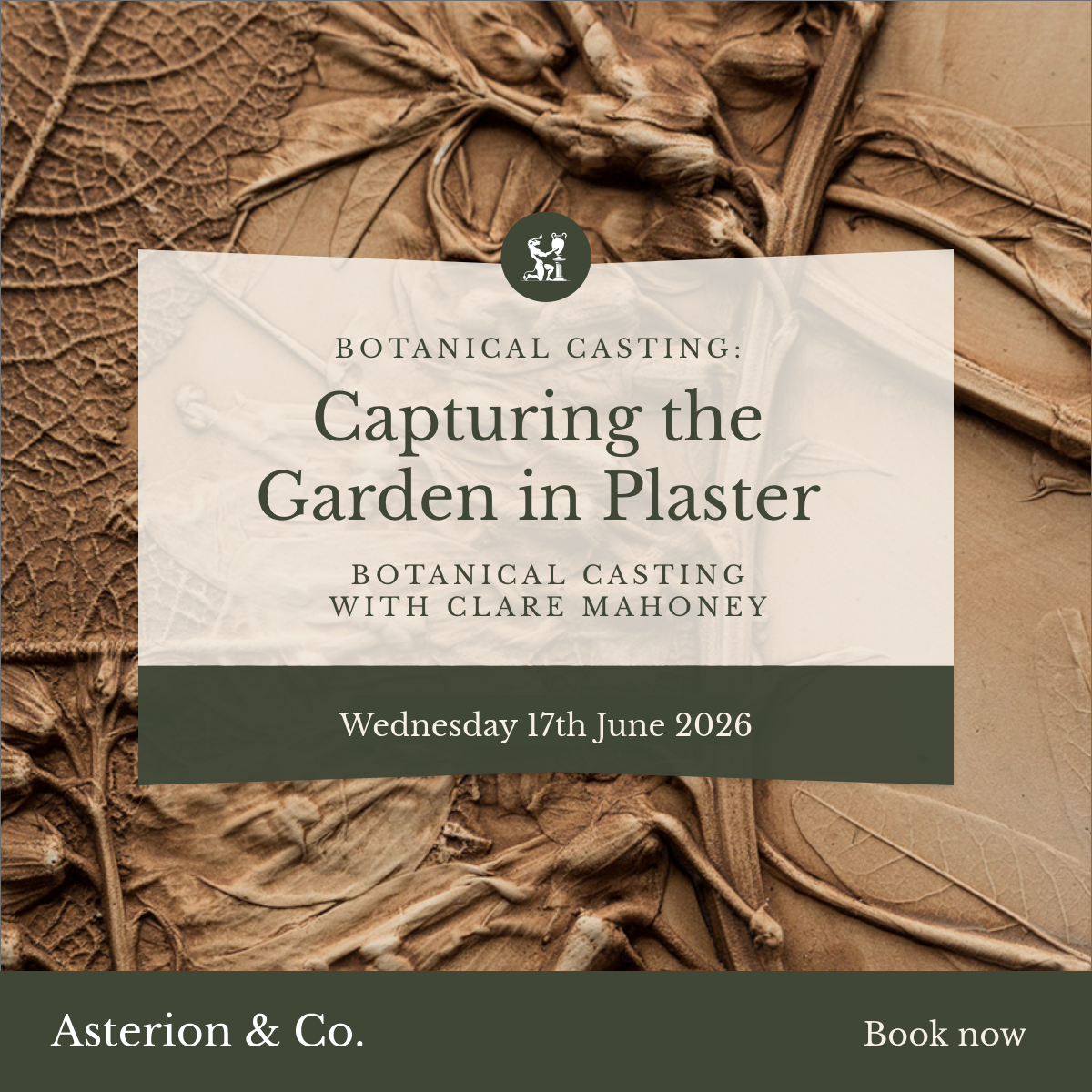
Clare’s upcoming botanical casting workshops with Asterion & Co. invite guests into that tension — and into the rare pleasure of making something both immediate and lasting. If you would like to spend a day learning this gentle, attentive craft in the calm of The Old Vicarage in Leigh-on-Mendip, you would be very welcome.
See the listings on Saturday 9th May and Wednesday 17th June 2026 for details.