Soft Fruit in Britain: Lineage, Movement and the Making of the Kitchen Garden
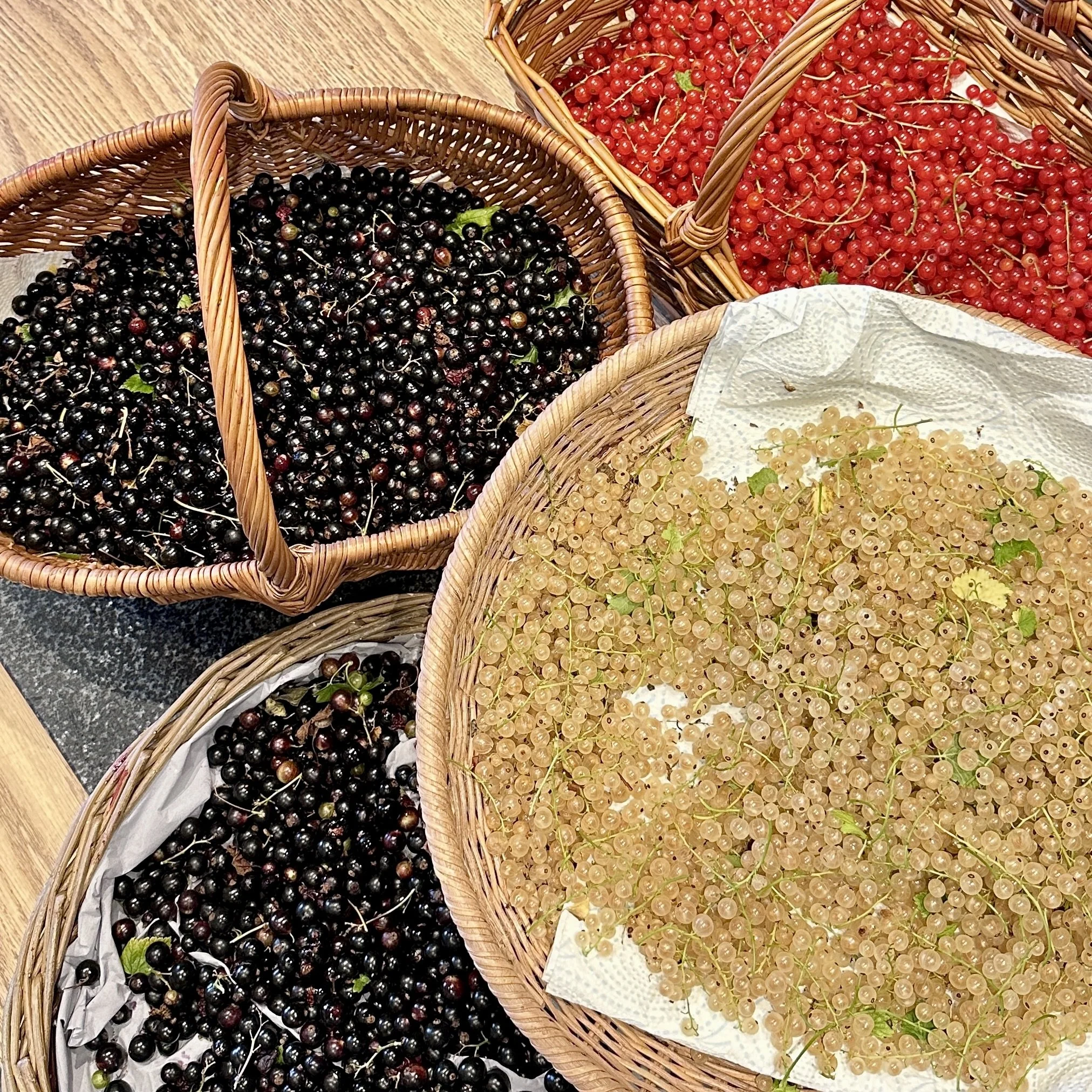
A full kitchen garden harvest in baskets: blackcurrants, redcurrants and whitecurrants at their peak, gathered at The Old Vicarage, Leigh-on-Mendip and ready for preserving.
A bowl of currants on a summer table can feel entirely of this place. Gooseberries stewed in a farmhouse kitchen, raspberries gathered warm from the cane, a handful of blueberries folded into cream. These fruits sit so comfortably within the British imagination that they appear native to it. And yet, their presence is the result of centuries of movement, selection and intent.
Soft fruit in Britain is not a static inheritance. It is a story of woodland plants drawn into cultivation, of monastic order shaping early gardens, of voyages carrying new species across continents, and of gardeners and nurserymen refining what they received.
Wild origins and early use
Blackcurrant and redcurrant, both of the genus Ribes, are native across northern and central Europe, extending into Siberia. They were known in Britain in the wild long before they were cultivated, growing in damp woodland margins and hedgerows. Gooseberries, Ribes uva-crispa, are similarly native, with records of wild gathering dating back to at least the medieval period.

Raspberries reward attention - keep pace with the picking, and they return it in abundance, day after day through the height of the season.
Raspberries, Rubus idaeus, have a longer documented cultural history. Classical writers including Pliny the Elder, writing in the 1st century AD, refer to the raspberry as growing on Mount Ida in what is now Turkey. The Romans are widely believed to have spread raspberries across Europe, encouraging their cultivation both for food and medicinal use.
By the Norman period, these fruits were known in England, but still close to their wild forms. Their transformation into recognisable garden crops would take place over the following centuries.
Monastic cultivation and medieval gardens
The first deliberate cultivation of soft fruit in Britain can be traced to monastic gardens between the 11th and 14th centuries. Monasteries such as Canterbury, Westminster and Glastonbury maintained physic gardens, where plants were grown for both food and medicine.
Currants and gooseberries were valued for their sharpness and preserving qualities. These gardens introduced order. Plants were no longer simply gathered, but planted, tended and selected. This marked the beginning of cultivation as a deliberate act rather than an incidental one.

Philip Miller’s Gardener’s Dictionary captures the moment British gardening began to turn from tradition into knowledge.
A defining record: Philip Miller, 1732
By the early 18th century, soft fruit had become sufficiently established to be formally documented. Philip Miller, head gardener of the Chelsea Physic Garden, published The Gardener’s Dictionary in 1731, with expanded editions circulating widely by 1732. It became one of the most influential horticultural texts of the period.
Miller records gooseberries, currants and raspberries as standard garden fruits, no longer curiosities but established crops. He distinguishes between red and white currants, and describes the cultivation of blackcurrants, noting their increasing use. Gooseberries are given particular attention, with reference to named varieties already in circulation, indicating that selection and improvement were well underway.
Raspberries are described in both red and white forms, with Miller noting differences in vigour and fruiting habit. What is striking is not simply their inclusion, but the level of detail. These are no longer wild fruits brought into the garden. They are plants being actively managed, differentiated and refined.
Miller’s work sits at a pivotal moment. It captures soft fruit at the point where tradition meets early horticultural science, where observation begins to formalise into knowledge that can be shared, repeated and improved upon.
The kitchen garden ascendant: 18th and 19th centuries
The later 18th century saw the rise of the walled kitchen garden as a defining feature of British estates. These spaces were engineered environments, designed to extend seasons and protect crops.
It is here that soft fruit was transformed.
Thomas Andrew Knight (1759–1838), a Herefordshire horticulturist and later President of the Royal Horticultural Society, advanced the science of fruit breeding. His work encouraged systematic selection, influencing how fruit crops, including soft fruit, were improved.

Gooseberries fruit on older wood, which is why careful, selective pruning year on year is what keeps a bush productive rather than congested.
Gooseberries became the subject of extraordinary attention. In the industrial north of England, particularly in Lancashire and Cheshire, gooseberry societies flourished from the late 18th century. Competitions for the largest fruit became highly organised events. By the 1820s, individual berries weighing over 30 grams were recorded. Named varieties such as ‘Roaring Lion’ and ‘Lancashire Lad’ reflect a culture of precision and pride.
Currants and raspberries were refined alongside them. Selection focused on yield, flavour and reliability, with varieties stabilised and distributed through an expanding nursery trade.
Nurseries such as those of Lee and Kennedy in Hammersmith, and later Veitch Nurseries in Exeter, became central to this system. Their catalogues, circulating widely by the early 19th century, shaped what was grown across Britain.
Transatlantic exchange and new arrivals
Blueberries represent a later chapter. While Britain has its native bilberry, the cultivated highbush blueberry is North American. Its domestication began in the early 20th century through the work of Frederick Coville and Elizabeth White in New Jersey. These plants were introduced to Europe later in the century, gradually establishing themselves in British gardens.
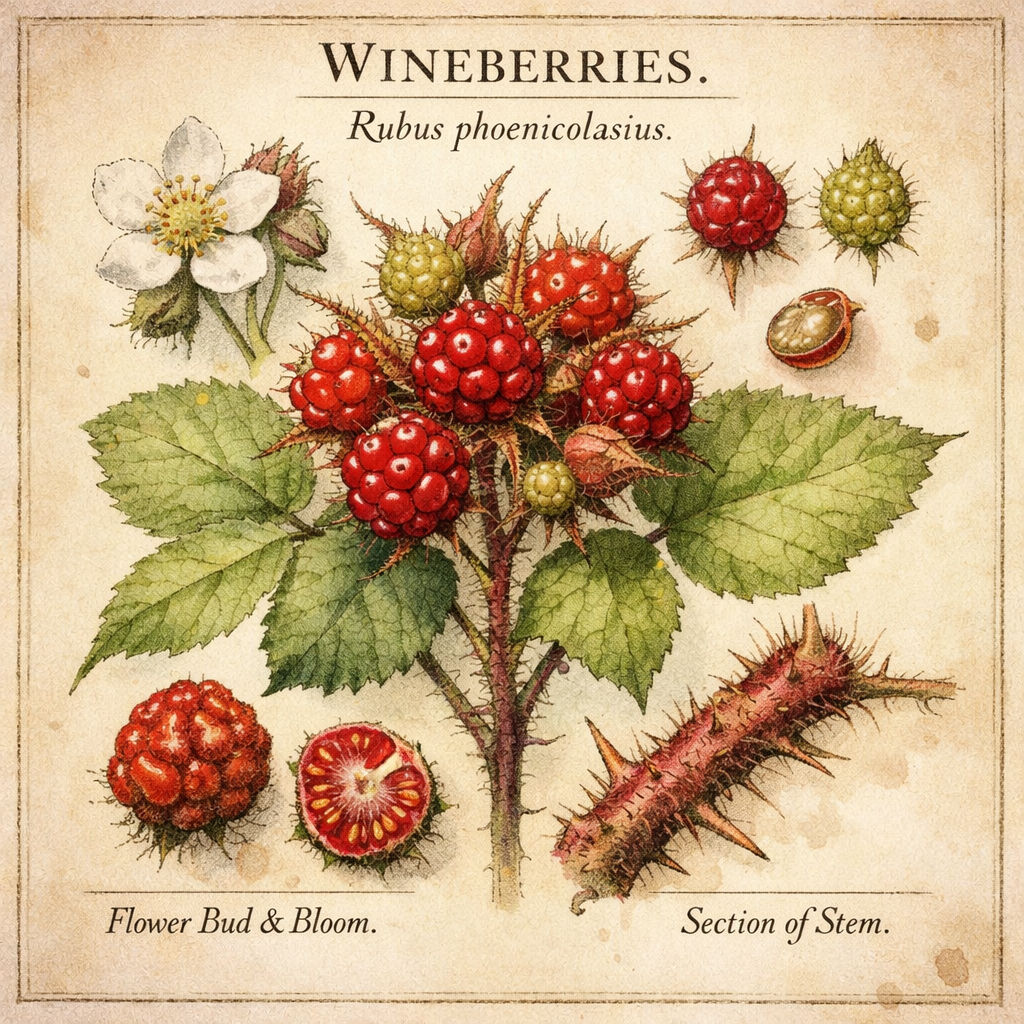
Wineberries carry their fruit in a distinctive, sticky red calyx that protects the berries as they ripen, giving them their jewel-like appearance before they are revealed.
Wineberries arrived earlier, introduced from East Asia in the late 19th century, around the 1870s, as part of a wider movement of botanical exchange. Honeyberries, long grown in Russia and Japan, are more recent additions to British cultivation, gaining wider recognition in the late 20th and early 21st centuries.
These introductions extend an established pattern. Plants move, are tested, adapted and eventually absorbed into the working garden.
Preservation and continuity
By the mid 20th century, commercial agriculture began to favour uniformity over diversity. Many older varieties fell out of use.
Their survival depends on preservation through cultivation. The National Fruit Collection at Brogdale maintains extensive records, while specialist nurseries continue to propagate heritage varieties, ensuring they remain part of the living garden.
This is not nostalgia. It is continuity.
A living inheritance
What we recognise today as soft fruit in Britain is the result of layered histories. Native plants gathered from woodland. Monastic cultivation introducing order. Early documentation through figures such as Philip Miller. Refinement in the walled gardens of estates. Expansion through nurseries and exchange.
These fruits are not simply grown. They are inherited.
To work with currants, gooseberries, raspberries or blueberries is to step into that continuum. The act is modest, but the lineage is not. It carries within it centuries of attention, adaptation and care.
Learn from Pennard Plant’s Chris Smith…
If this history resonates, why not explore Pennard Plants’ extensive range of soft fruits available to order online. Growing your own means you engage directly with this lineage.
Check out Pennard Plant’s extraordinarily wide range of berries, including some more unusual varieties such as funberries, fourberries and Japanese Wineberries, as well as, grapevines here.